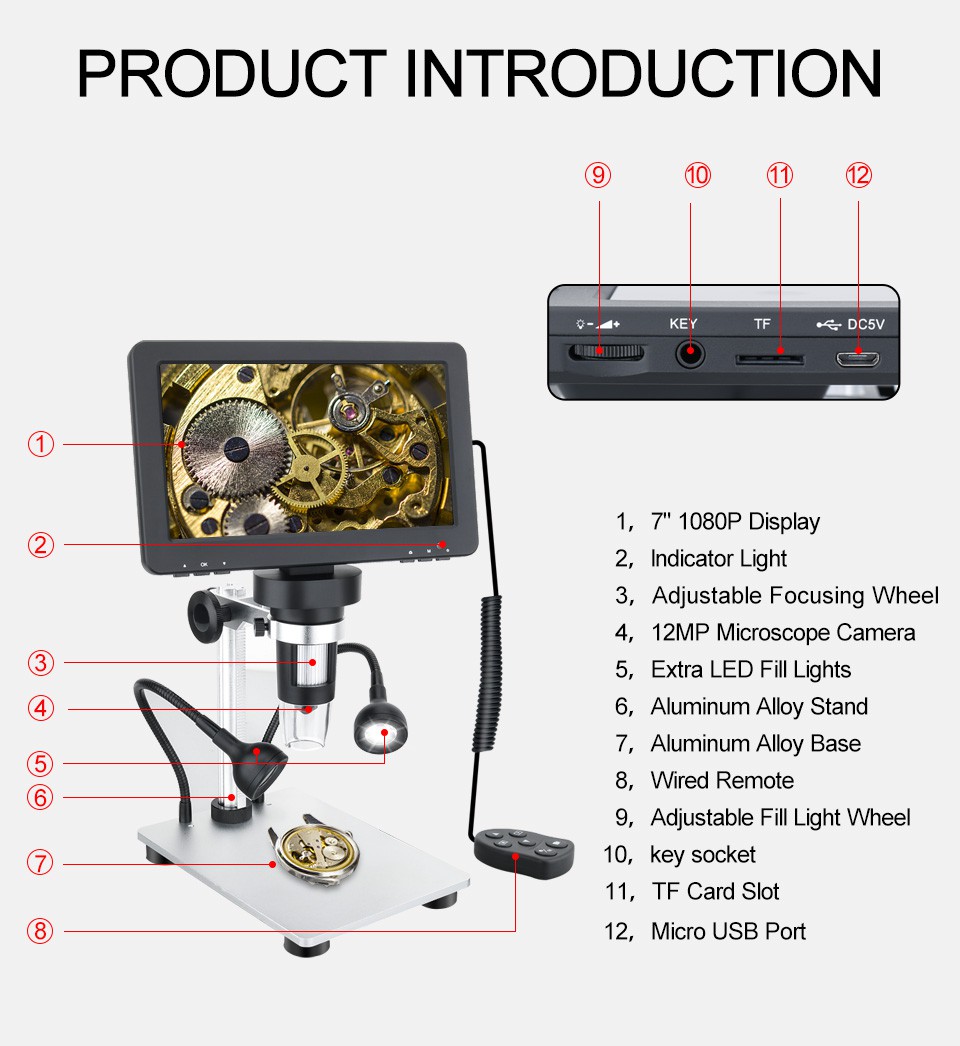
Components of a digital microscope
The digital microscope includes three parts: optical system, mechanical device and digital camera system (microscope camera):
(1) Optical system
1. eyepiece
It is a lens inserted on the top of the eyepiece tube, which consists of a group of lenses, which can make the objective lens resolve and magnify the object image multiple times, such as 10X, 15X, etc. According to the size of the field of view that can be seen, eyepieces can be divided into ordinary eyepieces with a smaller field of view and large-field eyepieces (or wide-angle eyepieces) with a larger field of view. The eyepieces of higher-end digital microscopes are also equipped with a diopter adjustment mechanism, so that the operator can adjust the diopter of the left and right eyes easily and quickly; Always focus clearly on the focal plane of the specimen; and, to prevent removal of the eyepieces and reduce the possibility of damage during transport, the eyepieces can be locked.
2. objective lens
It is installed on the hole of the converter, and it is also composed of a set of lenses, which can clearly magnify the object. The magnification is engraved on the objective lens, mainly 10X, 40X, 50X, 100X and so on. Liquid immersion objectives are often used in high-power objective lenses, that is, a liquid (such as fir oil) with a refractive index of about 1.5 is filled between the lower surface of the objective lens and the upper surface of the specimen, which can significantly improve the resolution of microscopic observation.
3. Light sources include halogen lamps, tungsten lamps, mercury lamps, fluorescent lamps, metal halide lamps, etc.
4. condenser
Including condenser, aperture diaphragm. The condenser is composed of a lens, which can concentrate the transmitted light, so that more light can be concentrated to the observed part. The aperture stop controls the light transmission range of the condenser to adjust the intensity of the light.
(2) Mechanical device
1. Frame The main body of a digital microscope, including the base and curved arms.
2. eyepiece tube
Located above the frame, it is fixed with the frame by a circular dovetail slot, and the eyepiece is inserted into it. According to whether there is a camera function, it can be divided into binocular tube and trinocular tube; according to the adjustment method of interpupillary distance, it can be divided into hinge type and translation type.
3. Nozzle
It is a rotating disc with 3 to 5 holes, which are respectively equipped with low magnification or high magnification objective lenses. The objective lens of different magnification can be entered into the working light path by rotating the objective lens converter.
4. Stage
It is a platform for placing glass slides, and there is a light hole in the center. There is an elastic specimen holder on the stage to hold the slides. There is a moving handle at the lower right, so that the stage can be moved in both XY directions.
5. Focusing mechanism
The focusing mechanism can be driven by the focusing handwheel to make the stage move up and down for coarse adjustment and fine adjustment, so that the observed object can be clearly focused and imaged.
6. Condenser adjustment mechanism The condenser is installed on it, and the adjustment screw can make the condenser go up and down to adjust the intensity of light.
(3) Digital camera system or microscope camera
1. Microscope camera: Generally, CCD microscope camera and CMOS microscope camera are commonly used. New sCMOS cameras and EMCCD cameras are also used. CCD is a high-end product with good image quality and color reproduction. CMOS cameras are cost-effective and Begin to gradually replace the CCD microscope camera.
2. frame grabber
3. software
4. Microcomputer