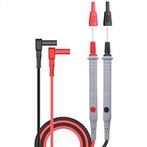
Detailed instructions on how to use the inductive digital display electric pen
Button Description:
A key "DIRECT": for the direct measurement key (away from the LCD screen), that is, with the metal front end of the pen (referred to as the batch head) direct contact with the line, please press this button;
B button "INDUCTANCE": for the induction / breakpoint measurement key (closer to the LCD screen), that is, with the batch head induction (note that the induction, rather than direct contact) line, please press this button.
Regardless of how the text is printed on the pen, in general, the one farther away from the LCD screen is the direct measurement key, and the one closer to the LCD screen is the sense/breakpoint measurement key. If this is not the layout, it indicates a cottage or poor quality products, for your safety, do not recommend buying.
Direct Measurement: 1.
1. Touch the DIRECT key, the metal front end of the stylus directly contact the object to be detected.
1.1 The last figure for the measured voltage value (the stylus is divided into 12V, 36V, 55V, 110V, 220V five voltage values, usually ≤ 36V is not life-threatening);
1.2 Not to the high section of the display value of 70%, the display of the low section of the value;
1.3. when measuring DC power that is not to ground, the hand should touch the other pole (such as positive or negative)
2. When the pen is in direct contact with the fire wire, the indicator will light up immediately whether or not the hand has touched either of the measurement keys:
2.1 When the hand does not touch any of the measurement keys, the indicator lights up and displays 12V, which is not permitted;
2.2 When the hand touches the inductive/breaking point measuring key, the indicator lights up and displays 110V, which is not permitted;
2.3 When the hand touches the direct measurement key, the indicator lights up and displays 220V, which is an accurate value;
2.4 In summary, if the indicator lights up without the hand touching any of the measurement keys, it indicates the presence of 220V on the AC line!
3. when the hand touches the direct measurement key, when the pen directly touches the human body, the fire wire, the zero wire, the ground wire, the metal and other conductive objects, the indicator light may come on, then the actual voltage is based on the readings, if there is no reading, it indicates that there is no voltage. 4. when the hand touches the inductive / disconnecting key, it indicates that there is no voltage.
4. When the hand touches the inductive/breakpoint measurement key, there are two situations when the pen directly touches the detected object:
4.1 The indicator light is on and 110V is displayed, which indicates that there is an alternating current of 220V on the firewire, remember to remember!
4.2 The indicator does not light up, but there is a "high voltage symbol", please refer to the "three, indirect detection" in the 1, 2 points.
Indirect detection (also known as inductive detection). 1:
1. Induction detection: Touch the induction/breakpoint measurement (INDUCTANCE) key, the metal front end of the stylus is close to (note that it is close to, not in direct contact with) the object to be detected, if the display appears "high-voltage symbols", it means that the object to be detected with the internal AC current.
2. Breakpoint detection: Measurement of broken wires, touch the INDUCTANCE key, the metal front end of the stylus is close to (note that it is close to, not in direct contact with) the wire, or direct contact with the insulation of the wire, if the "high-voltage symbol" disappears, it is the breakpoint here.
3. The use of this function can easily distinguish between zero and phase lines (to increase the distance between the lines when measuring side-by-side lines). Detection of microwave radiation and leakage.
Precautions:
1. The button does not need to be pressed hard.
2. The two measurement keys should not be touched at the same time when testing, otherwise it will affect the sensitivity and test results.