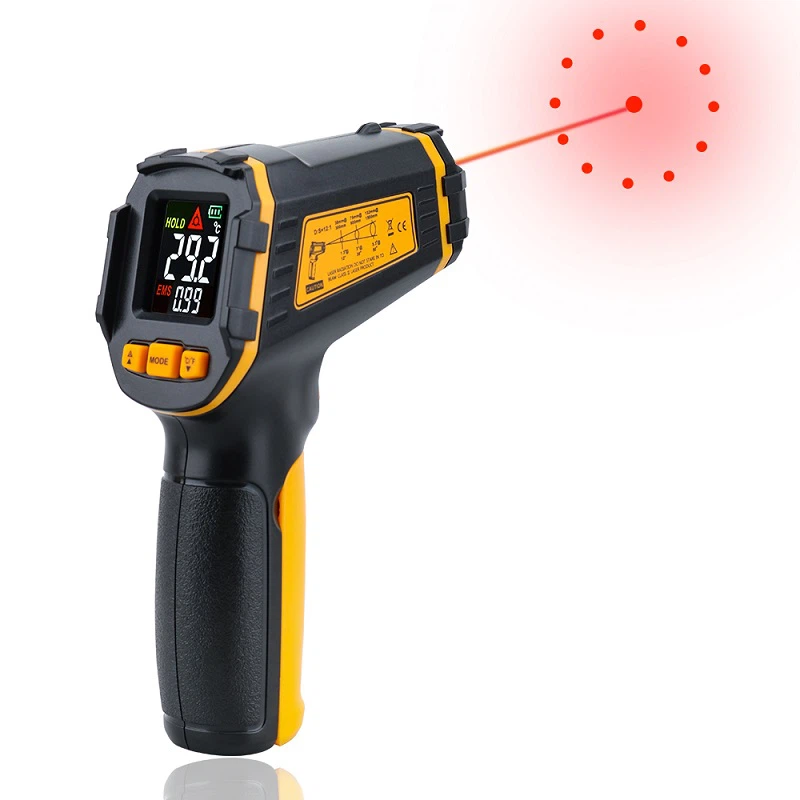
Detailed Introduction to the Functions of Ionic Infrared Thermometers
The infrared thermometer has an ionization chamber, and the artificial radioactive element used in the ionization chamber, Am 241 (Am241), has an intensity of about microcuries. Under normal circumstances, it is in equilibrium with an electric field. When smoke enters the ionization chamber, the positive and negative ions generated by ionization disturb the normal movement of charged particles. Under the effect of the electric field, they move towards the positive and negative electrodes respectively, disrupting the balance between the ionization chambers inside and outside, and causing changes in current and voltage. Ionic infrared thermometer is a device that senses the microcurrent changes of smoke particles through voltage changes caused by ionization chambers equivalent to smoke sensitive resistors. Then the microscopic manifestation is that the addition of equivalent resistance to the ionization chamber leads to an increase in voltage at both ends of the chamber, which is used to determine the smoke situation in the air.
The MTi-15 ion infrared thermometer uses trace amounts of artificial radioactive substance americium-241 internally. Because the thermometer body is covered by a metal shell, radiation will never leak and users can use it with confidence. In addition, its radiation energy only uses 55% of NIS-09C, so countries that have restrictions on the use of radiation energy can also use it with confidence. Moreover, the foot equipment and output characteristics of this thermometer are interchangeable with products from other companies. The MTi-15 source chip uses low radiation energy and appropriately expands the ionization chamber, resulting in a more stable balanced voltage during moisture cleaning, greatly reducing false alarm rates. The MTi-15 ion infrared thermometer is an advanced and reliable thermometer, widely used in various fire alarm systems, with functions far superior to gas sensitive resistance fire alarms.
Comparison between photoelectric smoke alarm and ion infrared thermometer:
There is an optical maze inside the photoelectric smoke alarm, which is equipped with an infrared tube. When there is no smoke, the infrared receiving tube cannot receive the infrared light announced by the infrared emitting tube. When smoke enters the optical maze, it undergoes refraction and reflection, and the receiving tube receives the infrared light. The intelligent alarm circuit determines whether the threshold is exceeded, and if it exceeds the threshold, an alarm is announced. Ionic smoke detectors need to be more responsive to small smoke particles and can respond evenly to various types of smoke; The forward facing photoelectric smoke alarm is more responsive to slightly larger smoke particles, but less responsive to gray and black smoke. When a raging fire breaks out, there are more small particles of smoke in the air, while during smoldering, there are slightly larger smoke particles in the air. If a fire breaks out and a lot of fine particles of smoke are released, the ion smoke alarm will sound the alarm first than the photoelectric smoke alarm. These two types of smoke alarms are not very close in time, but the extension of such fires is extremely fast. It is recommended to install ion smoke alarms in such places. After another type of smoldering fire occurs, there are many slightly larger smoke particles, and the photoelectric smoke alarm will sound the alarm first than the ion smoke alarm. This type of place advocates installing photoelectric smoke alarms. If you want to combine the interests of both, you can install both types of smoke alarms in the area where they are needed.