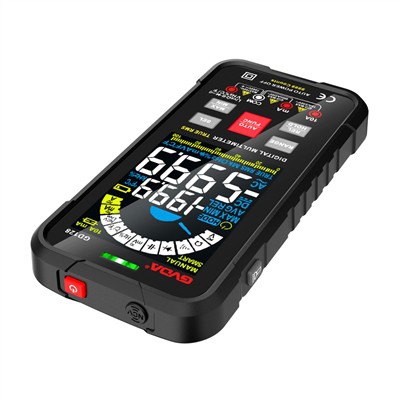
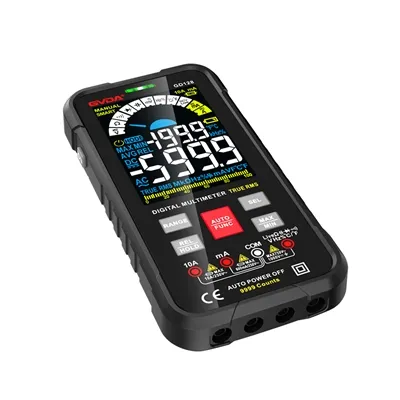
Digital multimeter related knowledge
Basic outline
Digital multimeters are available as portable units for basic fault diagnosis, as well as those placed on a workbench, and some have a resolution of seven or eight digits.
introduce
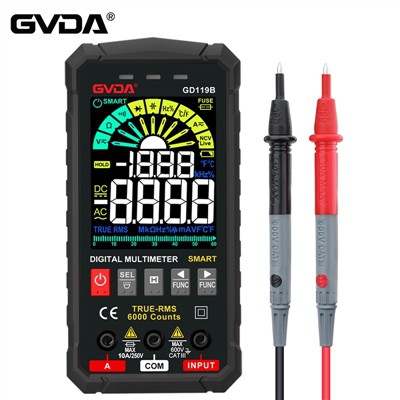
A digital multimeter (GMM) is an electronic instrument used in electrical measurements. It can have many special functions, but the main function is to measure voltage, resistance and current. Digital multimeter, as a modern multi-purpose electronic measuring instrument, is mainly used in physical, electrical, electronic and other measurement fields.
Resolution
Resolution refers to how well a meter measures. Knowing the resolution of a meter lets you know if you can see small changes in the signal being measured. For example, if the DMM has a resolution of 1mV over a 4V range, you can see a tiny change of 1mV (1/1000 of a volt) when measuring a 1V signal
If you're measuring less than 1/4 inch (or 1mm) in length, you're definitely not going to use a ruler with the smallest unit in inches (or centimeters). If the temperature is 98.6°F, it's useless to measure with a thermometer that only has integer marks. You need a thermometer with a resolution of 0.1°F.
The number of digits and words are used to describe the resolution of the table. Multimeters are categorized by the number of digits and words they can display.
A 3-and-a-half-digit meter can display three full-digit digits from 0 to 9, and one half-digit (only 1 or no display). A 3½-digit digital meter can achieve a resolution of 1999 words. A 4½-digit digital meter can achieve a resolution of 19999 words.
The resolution of digital tables is better in words than in bits, and the resolution of 3½-digit tables has been increased to 3200 or 4000 words.
The 3200-word digital meter provides better resolution for some measurements. For example, a 1999 word meter, when measuring voltages greater than 200V, you can't display 0.1V. The 3200-character digital meter can still display 0.1V when measuring the voltage of 320V. When the measured voltage is higher than 320V and the resolution of 0.1V is to be achieved, an expensive 20,000-character digital meter should be used.
precision
Accuracy refers to the maximum allowable error that occurs in a specific use environment. In other words, precision is used to indicate
How close the DMM's measurement is to the actual value of the signal being measured.
For DMMs, accuracy is usually expressed as a percentage of reading. For example, the meaning of 1% reading accuracy is: when the display of the digital multimeter is 100.0V, the actual voltage may be between 99.0V and 101.0V.
Specific values may be added to the basic accuracy in the detailed description. Its meaning is the number of words to be added to transform the right end of the displayed *. In the previous example, the accuracy might be marked as ±(1%+2). Therefore, if the GMM reads 100.0V, the actual voltage will be between 98.8V and 101.2V.
The accuracy of an analog meter is calculated in terms of full-scale error, not the displayed reading. The typical accuracy of an analog meter is ±2% or ±3% of full scale. The typical basic accuracy of a DMM is between ±(0.7%+1) and ±(0.1%+1) of reading, or even higher.
Digital and analog displays
In terms of accuracy and resolution, digital displays have great advantages, and measurements can be displayed with three or more digits.
Analog pointers are slightly inferior in accuracy and resolution. Because you have to estimate the position of the pointer.
The bar graph simulates the change and trend of the signal like a pointer. But it's more durable and less damaged.
resistance
Resistance is measured at the electrical barrier. Resistance values vary widely, from a few milliohms (mΩ) to contact resistance to billions of ohms to insulation resistance. Many DMMs measure resistances as small as 0.1 ohms, and some measurements can be as high as 300 megohms (300,000,000ohms). If the resistance is extremely large, the Fluke multimeter will display "OL", indicating that the measured resistance exceeds the range. When measuring an open circuit, "OL" is displayed.
Resistance must be measured with circuit power off, otherwise damage to the meter or circuit board will occur. Some digital multimeters provide a function of protection when a voltage signal is mistakenly connected in resistance mode. Different models of DMMs have different protection capabilities.
When making accurate measurements of low resistance, the resistance of the measurement lead must be subtracted from the measurement. Typical test lead resistance values are between 0.2Ω and 0.5Ω. If the resistance of the test leads is greater than 1Ω, the test leads should be replaced.
If the digital multimeter supplies less than 0.6V DC voltage to measure the resistance, it can measure the resistance value of the circuit board isolated by the diode or semiconductor. It can be tested without removing the resistor.
On and off
Continuity is the distinction between a circuit or a short by a quick resistance measurement.
On-off measurement is simpler and faster with a DMM with on-off beep. When a short circuit is detected, the watch beeps, so there is no need to look at the watch during the test. Different models of DMMs have different trigger resistance values.
Diode Test
A diode is like an electronic switch. If the voltage is above a certain value, the diode will conduct. Typically a silicon diode turn-on voltage is 0.6V. And diodes only allow current to flow in one direction.
When checking diodes or junctions, the multimeter will not only give a wide reading range but also drive currents greater than 50mA. (see Table 1)
When measuring the resistance of circuits containing diodes, the test voltage of the DMM will be lower than 0.6V, preventing the crystal junction from conducting.
When selecting a diode test, the test voltage is raised in order to check the functionality of the diode or semiconductor crystal.
Some DMMs have a diode test function. This function measures and displays the actual voltage drop across the diode. The voltage drop of the silicon junction should be less than 0.7V during forward testing, and the circuit will be open during reverse testing.
How to Test Resistance
1. Turn off the circuit power
2. Select electric blocking
3. Insert the black test lead into the COM jack. Insert the red test lead into the resistance test jack
4. Connect the test lead probe to both ends of the component or circuit under test
5. Check the reading and note the unit of ohm (Ω), kilo-ohm (kΩ), or megohm (MΩ).
Note: 1,000Ω=1KΩ; 1,000,000Ω=1MΩ
It is important to note: Turn off the power when testing resistance.
measure current
Current measurement is not the same as measuring other quantities with a DMM. The direct current measurement method is to connect the digital multimeter directly to the circuit under test, so that the current of the circuit under test flows directly into the internal circuit of the multimeter. The indirect measurement method does not require opening the circuit and stringing the multimeter to the circuit under test. The indirect method uses a current clamp.
Direct current measurement
1. Turn off the circuit power
2. Disconnect or desolder the circuit in order to string the meter into the circuit
3. Select the corresponding AC (A~), DC (A--) gear
4. Insert the black test lead into the COM socket and the red test lead into the 10A jack (10A) or the 300mA jack (300mA). The choice of which jack is mainly based on the possible measurements.
5. Connect the test leads to the disconnected circuit part in series.
6. Turn on the circuit power
7. Observe the reading and note the unit.
Note: When measuring DC, if the test probe is reversely connected, "-" will appear.
input protection
A common mistake is to put the test leads in the current jacks while trying to test the voltage. Small value resistors in DMMs can short-circuit the voltage source. A large current flows through the digital multimeter. If the multimeter is not adequately protected, it will not only damage the meter and circuit, but also harm the operator. In the case of high-voltage circuits (480 volts or higher), there is a greater danger.
Therefore, the digital multimeter should have a large enough current input protection fuse. Meters without current input fuses cannot be used in high energy circuits (>240V ac). Use a DMM with a fuse that has enough capacity to remove high-energy faults. The voltage rating of the fuse should be greater than the maximum voltage you expect. For example, a 20A, 250V fuse in a multimeter cannot provide protection when the multimeter measures a 480V circuit. A 20A, 600V fuse can play a protective role when the multimeter measures a 480V circuit.