Easy Way to Distinguish Neutral and Live Wires with a Multimeter, as well as Maintenance and Servicing
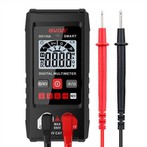
You can easily measure the neutral and live wires in your home with a multimeter, as long as you use a digital multimeter, clamp type multimeter, or pointer mechanical multimeter for the AC voltage range.
The range switch of a multimeter should be set to the AC voltage range (all multimeters should have this function, with a range from 200mV to 750V, generally selecting the 200V range. Some clamp type meters do not have the 200V range and can choose a larger range). If the range of the pointer multimeter needs to be smaller, you can choose 10V100V)
Then insert the red and black probes into the V/COM ports (the sockets used to measure the 220V voltage of household appliances)
Wrap the black probe wire 2-3 times in the left hand (as shown in the picture), of course, the more the better. Note that the metal needle of the black probe should not touch the hand at this time to prevent electric shock.
Then you can test it. Take the red probe and measure the socket or neutral wire separately. Record the results of the two measurements, and there must be a large and a small voltage between them. The larger voltage measured is the live wire, and the smaller voltage value is of course the neutral wire. If the ground wire is measured, there must be no smaller voltage or even no voltage (depending on whether your home's ground wire is connected)
By distinguishing the measured values of the voltage between the neutral and live wires, it is clear at a glance.
Maintenance of multimeter
1. Appearance inspection
If any issues such as wire breakage, desoldering, grounding short circuit, fuse tube breakage, or component burnout are found, the temperature rise of the battery, resistor, transistor, or integrated block can be touched, and the cause of the abnormal temperature rise can be identified by referring to the circuit diagram.
2. Voltage measurement method
Measuring the working voltage of each key point can quickly identify the fault point. Measure the operating voltage, reference voltage, etc. of the A/D converter.
3. Short circuit method
The short-circuit method is generally used in the inspection of A/D converters, which is more commonly used in repairing weak and micro electrical instruments.
4. Circuit breaking method
Disconnect the suspicious part from the entire machine or unit circuit. If the fault disappears, it indicates that the fault is in the disconnected circuit. This method is mainly suitable for situations where there is a short circuit in the circuit.
5. Component measurement method
When the fault has narrowed down to one or several components, it can be measured online or offline. If necessary, replace with good components. If the fault disappears, it indicates that the component is broken.