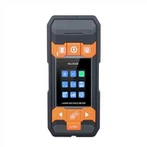
Far infrared thermometer performance indicators
1. Determine the temperature measurement range: The temperature measurement range is the most important performance indicator of the thermometer. Each model of thermometer has its own specific temperature measurement range. Therefore, the user's measured temperature range must be considered accurately and comprehensively, neither too narrow nor too wide. According to the blackbody radiation law, the change in radiated energy caused by temperature in the short-wavelength band of the spectrum will exceed the change in radiated energy caused by the emissivity error.
2. Determine the target size: Infrared thermometers can be divided into single-color thermometers and double-color thermometers (radiation colorimetric thermometers) according to the principle. For a monochromatic thermometer, when measuring temperature, the measured target area should fill the field of view of the thermometer. It is recommended that the size of the measured target exceeds 50[%] of the field of view. If the target size is smaller than the field of view, the background radiation energy will enter the visual and acoustic signals of the thermometer and interfere with the temperature measurement reading, causing errors. In contrast, if the target is larger than the thermometer's field of view, the thermometer will not be affected by the background outside the measurement area. For two-color thermometers, the temperature is determined by the ratio of radiated energy in two independent wavelength bands. Therefore, when the measured target is small, does not fill the field of view, and there are smoke, dust, and obstructions on the measurement path, which attenuate the radiation energy, it will not have a significant impact on the measurement results. For small targets that are in motion or vibrating, a two-color thermometer is the best choice. This is due to the small diameter and flexibility of light, which can transmit optical radiation energy in curved, blocked and folded channels.
3. Determine the distance coefficient (optical resolution): The distance coefficient is determined by the ratio D:S, that is, the ratio of the distance D between the thermometer probe and the target to the diameter of the measured target. If the thermometer must be installed far away from the target due to environmental conditions, and small targets need to be measured, a thermometer with high optical resolution should be selected. The higher the optical resolution, that is, the higher the D:S ratio, the higher the cost of the thermometer. If the thermometer is far away from the target and the target is small, a thermometer with a high distance coefficient should be selected. For a thermometer with a fixed focal length, the focus of the optical system is the smallest position of the light spot, and the light spot will increase both near and far from the focus position. There are two distance coefficients.
4. Determine the wavelength range: The emissivity and surface characteristics of the target material determine the corresponding wavelength of the spectrum of the thermometer. For high-reflectivity alloy materials, there are low or varying emissivities. In high-temperature areas, the best wavelength for measuring metallic materials is near-infrared, which can be 0.8 to 1.0 μm. Other temperature zones are available: 1.6μm, 2.2μm and 3.9μm. Since some materials are transparent at certain wavelengths, infrared energy will penetrate these materials, and a special wavelength should be selected for this material.
5. Determine the response time: The response time indicates the response speed of the infrared thermometer to the change of the measured temperature. It is defined as the time required to reach 95[%] of the energy of the final reading. It is related to the photoelectric detector, signal processing circuit and display system. related to the time constant. If the target moves very fast or when measuring a rapidly heated target, a fast-response infrared thermometer should be used. Otherwise, sufficient signal response will not be achieved and the measurement accuracy will be reduced. However, not all applications require a fast-responding infrared thermometer. When there is thermal inertia for stationary or target thermal processes, the response time of the thermometer can be relaxed.
6. Signal processing function: In view of the difference between discrete processes (such as parts production) and continuous processes, infrared thermometers are required to have multiple signal processing functions (such as peak hold, valley hold, average value) for selection, such as temperature measurement conveyor belts When placing a bottle on the bottle, peak hold is used, and its temperature output signal is sent to the controller. Otherwise the thermometer reads a lower temperature value between bottles. If using peak hold, set the thermometer response time slightly longer than the time interval between bottles so that at least one bottle is always being measured.
7. Consideration of environmental conditions: The environmental conditions in which the thermometer is located have a great impact on the measurement results and should be considered and appropriately resolved, otherwise it will affect the temperature measurement accuracy and even cause damage. When the ambient temperature is high and dust, smoke and steam are present, accessories such as protective covers, water cooling, air cooling systems, and air purges provided by the manufacturer can be used. These accessories effectively address environmental influences and protect the thermometer for accurate temperature measurement. When determining accessories, standardize services should be requested whenever possible to reduce installation costs.
8. Calibration of infrared radiation thermometer: The infrared thermometer must be calibrated in order for it to correctly display the temperature of the target being measured. If the temperature measurement of the thermometer used is out of tolerance during use, it must be returned to the manufacturer or maintenance center for recalibration.