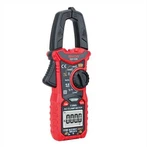
Function explanation for infrared thermometer signal processing
Infrared Thermometer Signal Processing Function Explanation Determining the Wavelength Range: The emissivity and surface properties of the online pyrometer target material determine the spectral response or wavelength of the pyrometer. For high reflectivity alloy materials, there is low or varying emissivity. In the high temperature area, the best wavelength for measuring metal materials is near infrared, and the wavelength of 0.18-1.0μm can be selected. Other temperature zones can choose 1.6μm, 2.2μm and 3.9μm wavelength. Since some materials are transparent at a certain wavelength, infrared energy will penetrate these materials, and a special wavelength should be selected for this material. For example, the wavelengths of 1.0μm, 2.2μm and 3.9μm are used to measure the internal temperature of the glass (the glass to be tested must be very thick, otherwise it will pass through) wavelengths; For example, the wavelength of 3.43 μm is used for measuring polyethylene plastic film, and the wavelength of 4.3 μm or 7.9 μm is used for polyester. If the thickness is more than 0.4mm, choose 8-14μm wavelength; for example, measure CO2 in flame with narrow band 4.24-4.3μm wavelength, measure CO in flame with narrow band 4.64μm wavelength, measure NO2 in flame with 4.47μm wavelength.
The signal processing function of the infrared thermometer is explained to determine the response time: the response time indicates the reaction speed of the infrared thermometer to the measured temperature change, which is defined as the time required to reach 95% of the energy of the final reading. It is related to the photodetector and the signal processing circuit. It is related to the time constant of the display system. This is much faster than contact temperature measurement methods. If the moving speed of the target is very fast or when measuring a rapidly heating target, a fast-response infrared thermometer should be selected, otherwise the sufficient signal response will not be achieved, and the measurement accuracy will be reduced. However, not all applications require a fast-response infrared thermometer. For static or target thermal processes where thermal inertia exists, the response time of the pyrometer can be relaxed. Therefore, the choice of the response time of the infrared thermometer should be adapted to the situation of the measured target.
Explanation of the signal processing function of the infrared thermometer Environmental considerations: The environmental conditions of the thermometer have a great impact on the measurement results, which should be considered and properly resolved, otherwise it will affect the temperature measurement accuracy and even cause damage to the thermometer. When the ambient temperature is too high and there is dust, smoke and steam, you can choose the protective cover, water cooling, air cooling system, air blower and other accessories provided by the manufacturer. These accessories can effectively address environmental influences and protect the thermometer for accurate temperature measurement. When specifying accessories, standardize service should be requested as much as possible to reduce installation costs. When smoke, dust or other particles reduce the measurement energy signal, a two-color thermometer is the best choice. Under noise, electromagnetic field, vibration or inaccessible environmental conditions, or other harsh conditions, the fiber optic two-color thermometer is the best choice.