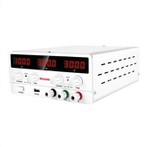
High frequency switching power supply, what does high frequency switching power supply mean
1. Review of the Development of DC Electroplating Power Supply
Electroplating is the process of converting electrical energy into chemical energy. In this process, metal ions obtain electrons and are reduced to metal atoms. Metal atoms are arranged according to certain rules to form crystals and become coatings. The DC electroplating power supply provides the "source" of electrons and the power to crystallize metal atoms. Therefore, the role of the power supply in the electroplating process is very important.
High frequency switching power supply
Before the mid-1960s, people used AC-DC generators to provide DC power for electroplating. When adjusting the output of the DC generator, the output of the DC generator is used as a sampling signal, and the speed of the AC motor is adjusted to change the DC output, which is the so-called "AC-DC-AC group". Due to its high reliability, this system once dominated the field of electroplating (there were also tribute arc rectifiers in the same period, but it was eliminated earlier.) People can still see it in some large domestic factories. their shadows. However, the efficiency of this system is extremely low, so it withdrew from the stage of history shortly after the birth of power electronics technology. We call the DC power supply system represented by AC and DC generator sets the first generation of DC electroplating power supply.
Before power electronics was differentiated from electrical technology, high-power silicon rectifiers had been widely used industrially. Therefore, in the field of electroplating, a so-called "self-coupling + silicon rectification" DC electroplating power supply appeared, that is, using auto-coupling The transformer regulates the AC voltage, and then rectifies it with a high-power silicon tube (stack). Although this system has made some progress compared with the "AC-DC generator set" in technology, it is very inconvenient because it needs to use a motor or manpower to drag the voltage regulating end of the autotransformer in the control. At the same time, its efficiency has not improved, and its precision and ripple are also poor. This is the so-called second-generation DC plating power supply.
In the mid-to-late 1950s, the thyristor was born in Bell Laboratories in the United States. Thus bringing revolutionary gospel to the power electronics industry including electroplating power supply. The DC electroplating power supply with thyristor as the core was produced under such a background.
SCR electroplating power supply mainly has two forms in terms of circuit structure: one is to use SCR to regulate voltage on the primary side of the power frequency transformer, and then use silicon tube multi-phase rectification on the secondary side; the other is to directly use SCR Voltage regulation and rectification are performed on the secondary side of the power frequency transformer. Regardless of the form, the mature regulation and control principle is applied to the control of the conduction angle of the thyristor through the electronic circuit, so that the output characteristics of the thyristor electroplating power supply are greatly superior to the previous products. Under rated load conditions, satisfactory accuracy, ripple and efficiency are often obtained, especially in efficiency, which has been significantly improved compared with past products, and the power range is also very wide. These excellent characteristics make it become the mainstream of DC electroplating power supply once it appears. So far, this kind of power supply is still used in large quantities in China, and it is also used in the field of high-power power supply in foreign industrialized countries. We call it the third generation DC electroplating power supply.
The third-generation electroplating products have obvious advantages over the previous products, but with the continuous improvement of people's requirements for coating quality and industrial production process automation, as well as human energy saving and pollution reduction in the industrial production field in the past ten years, The disadvantages of thyristor power supply are becoming more and more obvious. First of all, it can only guarantee the rated accuracy within a certain load range, but in actual production, most of the cases are non-rated, so it is often difficult to meet the actual accuracy requirements. The same is true for ripple, which only satisfies the rated value within a certain range (generally near full load). All of these make it difficult for people to use it to further improve the quality of the process. Secondly, because the analog electronic circuit is used to complete the phase-shift control, when it is connected with the computer control system, the required interface circuit is cumbersome and inconvenient. In addition, due to the inability to get rid of the power frequency transformer, the whole machine is bulky, heavy, consumes copper, and has serious harmonic interference to the power grid. With the development of power electronics technology, high-frequency power conversion technology has been more and more widely used. The fourth generation of DC electroplating power supply - high frequency switching power supply came into being under such a background.