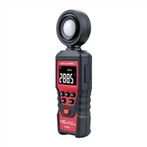
The digital multimeter is a multi-range digital multimeter DMM composed of a three-and-a-half or four-and-a-half-digit digital voltmeter DVM by expanding the range. The A/D converter ICL7106 and the three-and-a-half liquid crystal display form a 200mV Digital voltmeter, on the basis of this 200mV voltmeter head, a digital multimeter is formed by adding a voltage divider, a shunt, and a rectifier to expand the range. Its working principle: mainly to measure the voltage, current, AC voltage, AC The current, capacitance, inductance, and resistance are uniformly converted into DC voltage signals and attenuated to 200mV and then sent to the A/D converter for processing and display. The A/D converter can only recognize signals below 200mV, that is to say, regardless of the input signal Any signal must first be converted into a DC voltage signal, and the signal must be attenuated below 200mV through an attenuator and sent to the A/D converter for processing and display. This is equivalent to the working principle of a pointer multimeter. We know the pointer The working principle of the multimeter is to use a magnetoelectric micro-ampere DC ammeter as the meter head. On the basis of the head, the measurement range of the DC voltage range is expanded by dividing the voltage with the resistance in series with the meter head, and the measurement range of the DC current range is expanded by dividing the resistance with the resistance in parallel with the meter head. To expand the measurement range of the AC voltage range, rectify the AC signal into a DC signal and flow through the meter to measure. The pointer multimeter measures the resistance by voltammetry, which means that the resistance is measured according to the current flowing through the measured resistance. , if the resistance value of the resistance under test is larger, the current flowing through the resistance under test is smaller, which means that the resistance value of the resistance under test is large; otherwise, if the resistance value of the resistance under test is small, the current flowing through the resistance under test is also smaller. At this time, the larger the deflection angle of the pointer is, the smaller the resistance value of the measured resistance is, and the size of the resistance can be measured by this principle.
That is to say, the pointer multimeter needs to convert the voltage signal, current signal, AC voltage signal, resistance, etc. to be measured into a DC current signal through the internal voltage divider resistance, shunt resistance, and rectifier, and pass it into the meter for measurement.
The digital multimeter needs to convert the voltage signal, current signal, AC voltage signal, resistance, capacitance, inductance, diode, etc. to be measured uniformly to convert the DC voltage signal and attenuate it to below 200mV by the attenuator and send it to the A/D for processing and display. .
In other words, in a simple sentence, the head of the digital multimeter is its core, which is a digital voltmeter with a range of 200mV. On the basis of this voltmeter, the range is expanded to form a digital multimeter.