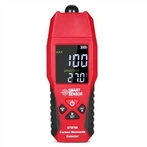
How a sound level meter works
The sound is converted into an electrical signal by the microphone, and the impedance is transformed by the preamplifier to match the microphone and the attenuator. The amplifier adds the output signal to the weighting network, performs frequency weighting on the signal (or external filter), and then amplifies the signal to a certain amplitude through the attenuator and amplifier, and sends it to the rms detector (or external power supply). flat recorder), the numerical value of the noise sound level is given on the indicator head.
Microphone
A microphone is a device that converts a sound pressure signal into a voltage signal, also known as a microphone, which is the sensor of a sound level meter. Common microphones are crystal type, electret type, moving coil type and condenser type.
1) The moving coil microphone is composed of a vibrating diaphragm, a movable coil, a permanent magnet and a transformer. The vibrating diaphragm starts to vibrate after being subjected to sound wave pressure, and drives the movable coil installed with it to vibrate in the magnetic field to generate induced current. The current varies according to the magnitude of the acoustic pressure on the vibrating diaphragm. The greater the sound pressure, the greater the current generated, and the lower the sound pressure, the less current generated.
2) Condenser microphones are mainly composed of metal diaphragms and metal electrodes that are close together, and are essentially a flat capacitor. The metal diaphragm and the metal electrodes constitute the two plates of the flat capacitor. When the diaphragm is subjected to sound pressure, the diaphragm is deformed, which changes the distance between the two plates, thus changing the capacitance. The voltage in the bit measurement circuit also changed, realizing the function of converting the sound pressure signal into a voltage signal. Condenser microphones are ideal microphones in acoustic measurement. They have the advantages of large dynamic range, flat frequency response, high sensitivity and good stability in general measurement environments, so they are widely used. Since the output impedance of the condenser microphone is very high, it is necessary to carry out impedance transformation through the preamplifier. The preamplifier is installed inside the sound level meter near the part where the condenser microphone is installed.
Amplifier
Generally, two-stage amplifiers are used, namely input amplifier and output amplifier, whose function is to amplify the weak electrical signal. The input attenuator and the output attenuator are used to change the attenuation of the input signal and the attenuation of the output signal, so that the pointer of the meter head points to the appropriate position. The adjustment range of the attenuator used by the input amplifier is the measurement low end, and the adjustment range of the attenuator used by the output amplifier is the measurement gao end. Many sound level meters have a 70dB limit on the high and low ends.
Weighted Network
A network that modifies the electrical signal to an approximate value of hearing is called a weighted network. The sound pressure level measured by the weighting network is no longer the sound pressure level of the objective physical quantity (called the linear sound pressure level), but the sound pressure level corrected by the sense of hearing, which is called the weighted sound level or the noise level.
The weighted (also called weighted) parameter is a parameter measured after some weighting processing is performed on the frequency response curve, in order to distinguish it from the unweighted parameter in the state of flat frequency response. For example, the signal-to-noise ratio, by definition, we measure the noise level (which can be power, voltage, or current) at the rated signal level. The ratio of the rated level to the noise level is the signal-to-noise ratio. If it is decibel value, then calculate the difference between the two. This is the unweighted signal-to-noise ratio. However, because the human ear has different perception capabilities of noise, it feels good for the intermediate frequency around 500Hz, but not for the high frequency. Therefore, the unweighted signal-to-noise ratio may not be consistent with the human ear's subjective perception of the noise level. .
How to unify the measured value with the subjective sense of hearing? So there is an equalization network, or a weighting network, which moderately attenuates the high frequencies, so that the intermediate frequencies are more prominent. This weighting network is connected between the equipment under test and the measuring instrument, so the influence of the intermediate frequency noise of the equipment will be "amplified" by the network. The measured signal-to-noise ratio is called the weighted signal-to-noise ratio, which can more truly reflect people's subjective sense of hearing.
Depending on the weighting network used, they are called A sound level, B sound level and C sound level. A-weighted sound level is to simulate the frequency characteristics of the human ear to low-intensity noise below 55dB, B-weighted sound level is to simulate the frequency characteristics of medium-intensity noise from 55dB to 85dB, C-weighted sound level is to simulate the frequency characteristics of high-intensity noise . The main difference between the three is the attenuation of the high-frequency components of the noise. A attenuates the most, B is the second, and C is the least.
However, since the equal-loudness curve on which A-weighting is based has undergone great changes after several revisions, the status of A-weighting is gradually declining.
Detector
The function of the detector is to convert the rapidly changing voltage signal into a slower changing DC voltage signal. The magnitude of this DC voltage is proportional to the magnitude of the input signal. According to the needs of measurement, the detectors are divided into peak detectors, average detectors and RMS detectors. The peak detector can give the maximum value in a certain time interval, and the average value detector can measure its absolute average value in a certain time interval. Pulse sound needs to measure its peak value, in most noise measurements, RMS detectors are used.
The rms detector can square, average and square the AC signal to obtain the rms value of the voltage, and finally transmit the rms voltage signal to the indicating meter.