How big is the error of infrared thermometer
Many infrared thermometers currently on the market are converted from industrial thermometers to meet the needs of SARS prevention. They are greatly affected by the ambient temperature at that time, and there is an error between the measured body temperature and the actual temperature.
Factors Affecting the Error of Infrared Thermometer
1. Radiation rate
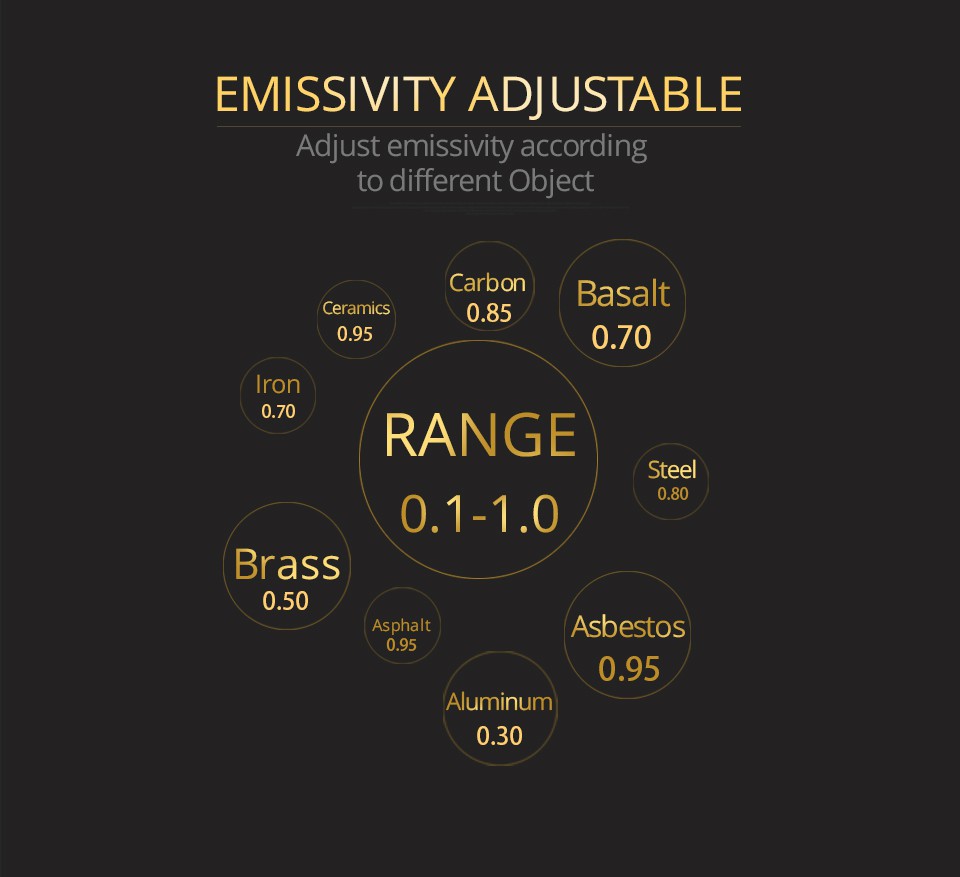
Emissivity is a physical quantity of an object’s radiation ability relative to a black body. It is not only related to the object’s material shape, surface roughness, unevenness, etc., but also related to the direction of the test. If the object is a smooth surface, its directionality is more sensitive. The emissivity of different substances is different, and the amount of radiation energy received by an infrared thermometer from an object is proportional to its emissivity.
(1) The emissivity is set according to Kirchhoff's theorem: the hemispherical monochromatic emissivity (ε) of the object surface is equal to its hemispherical monochromatic absorptivity (α), ε=α. Under thermal equilibrium conditions, the radiation power of an object is equal to its absorbed power, that is, the sum of the absorption rate (α), reflectivity (ρ), and transmittance (γ) is 1, that is, α+ρ+γ=1. For opaque (or with a certain thickness) object transmittance visible γ=0, only radiation and reflection (α+ρ=1), when the emissivity of the object is higher, the reflectivity is smaller, the influence of background and reflection The smaller the value is, the higher the accuracy of the test will be; on the contrary, the higher the background temperature or the higher the reflectivity, the greater the impact on the test. It can be seen from this that in the actual detection process, we must pay attention to the emissivity corresponding to different objects and thermometers, and set the emissivity as accurately as possible to reduce the error of the measured temperature.
(2) Test angle
The emissivity is related to the test direction. The larger the test angle, the greater the test error. This is easily overlooked when using infrared for temperature measurement. Generally speaking, the test angle is best within 30°C, and generally should not be greater than 45°C. If the test has to be greater than 45°C, the emissivity can be appropriately lowered for correction. If the temperature measurement data of two identical objects are to be judged and analyzed, then the test angle must be the same during the test, so that it is more comparable.
2. Distance coefficient
The distance coefficient (K=S:D) is the ratio of the distance S from the thermometer to the target and the diameter D of the temperature measurement target. It has a great influence on the accuracy of the infrared thermometer. The larger the K value, the higher the resolution . Therefore, if the thermometer must be installed far away from the target due to environmental conditions, and a small target is to be measured, a thermometer with high optical resolution should be selected to reduce the measurement error. In actual use, many people ignore the optical resolution of the thermometer. Regardless of the size of the diameter D of the target point to be measured, turn on the laser beam and align it with the measurement target for testing. In fact, they ignored the requirements of the S:D value of the thermometer, so the measured temperature will have a certain error.
3. Target size
The object to be measured and the field of view of the thermometer determine the accuracy of the instrument's measurement. When using an infrared thermometer to measure temperature, generally only the average value of a certain area on the surface of the measured target can be measured. Generally, there are three situations in the test:
(1) When the measured target is larger than the test field of view, the thermometer will not be affected by the background outside the measurement area, and can display the real temperature of the measured object located in a certain area within the optical target. At this time, the test effect is the best .
(2) When the measured target is equal to the test field of view, the background temperature has been affected, but it is still relatively small, and the test effect is average.
(3) When the measured target is smaller than the test field of view, the background radiation energy will enter the visual and acoustic symbols of the thermometer and interfere with the temperature measurement readings, causing errors. The instrument only displays the weighted average of the measured object and the background temperature.
4. Response time
The response time indicates the reaction speed of the infrared thermometer to the measured temperature change, which is defined as the time required to reach 95% of the energy of the final reading, which is related to the time constant of the photodetector, signal processing circuit and display system. If the moving speed of the target is fast or when measuring a fast-heating target, a fast-response infrared thermometer should be selected, otherwise the sufficient signal response will not be achieved and the measurement accuracy will be reduced. But not all applications require a fast-response infrared thermometer. For stationary or target thermal processes where thermal inertia exists, the response time of the pyrometer may be relaxed. Therefore, the choice of the response time of the infrared thermometer should be adapted to the situation of the measured target.