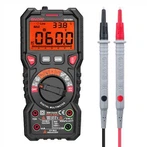
How do I use a multimeter to check to see if a line is shorted or grounded?
As the most common and practical instrument for electricians, a multimeter, although easy to use, can be said to have boundless power if used well. Here is a brief introduction to the usage of a multimeter and how to check if the circuit is short circuited or grounded, hoping to provide some inspiration for novice electricians.
The purpose of a multimeter
1. Use a multimeter to detect breakpoints in the wires.
Due to the insulation layer wrapped around the outer layer of the wire, it is difficult to identify the internal breakpoints. Using a traditional multimeter for detection is cumbersome and requires the use of a resistance barrier to check section by section, which is time-consuming and can easily damage the wire. Nowadays, numbers are much simpler. Connect one end of the wire to the phase wire and hang the other end in the air. With one hand holding the tip of the black pen and the other hand holding the red pen, slowly move the tip backwards along the insulation layer of the wire from one end of the grounding wire. When the voltage reading of the multimeter suddenly decreases (equivalent to one tenth of the original reading), the break point of the wire is located 15CM back from here.
Isn't it convenient to solve the problem by simply damaging one point of the wire using this method. This method can also detect the breakpoint of the electric blanket.
2. Use a multimeter to detect short circuit faults in the circuit.
When the wires in the household circuit are damaged or the circuit is aging, causing a short circuit between the live and neutral wires, it is generally difficult to determine where the short circuit point is. In this case, the resistance method of a multimeter can be used to easily find it. After a short circuit in the circuit, the main circuit breaker should be disconnected and all electrical appliances should be unplugged. Place the multimeter in the resistance range and connect the two probes to the live and neutral wires respectively. If the resistance value is zero or very small, it can be determined that there is a short circuit. It is necessary to measure the resistance value between the live and neutral wires section by section, and if necessary, cut off a section of the wire to determine the short-circuit point.