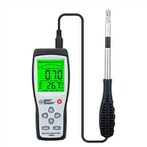
How does an anemometer work?
Working principle of anemometer The basic principle of anemometer is to place a thin metal wire in the fluid, and heat the wire through electric current;
Make its temperature higher than the temperature of the fluid, so the wire anemometer is called "dedicated line".
When the fluid flows through the wire in a straight direction, it will take away part of the heat from the wire, reducing the temperature of the wire.
According to the theory of forced convective heat exchange, it can be derived that there is a relationship between the heat Q lost by the dedicated line and the velocity v of the fluid. A standard dedicated wire probe consists of two brackets tensioning a short, thin wire.
Metal wire is generally made of platinum, rhodium, tungsten and other metals with high melting point and good ductility. The diameter of the commonly used wire is 5 μm and the length is 2 mm; the smallest probe has a diameter of only 1 μm and a length of 0.2 mm. It depends on different uses.
The dedicated line probe is also made into double wire, triple wire, oblique wire, V shape, X shape, etc. In order to increase strength, sometimes a metal film is used instead of a metal wire. Generally, a thin metal film is sprayed on a thermally insulating substrate, which is called a hot film probe.
The dedicated line probe must be calibrated before use. Static calibration is carried out in a dedicated specification wind tunnel.
Measure the relationship between flow rate and output voltage and draw a standard curve; dynamic calibration is carried out in a known pulsating flow field;
Or add a pulsating electrical signal to the heating circuit of the anemometer to check the frequency response of the dedicated line anemometer. If the frequency response is not good, it can be improved with a corresponding compensation circuit.