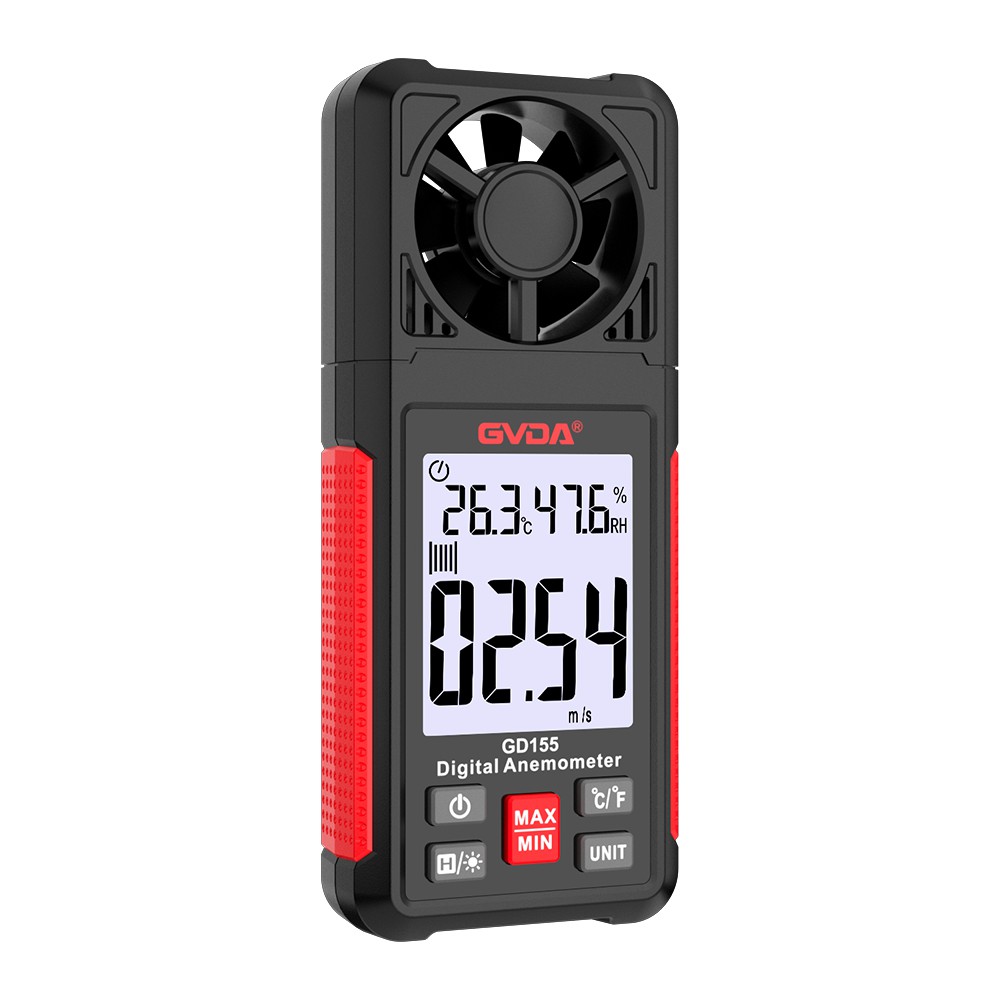
How does the pipeline wind speed sensor measure the pipeline's air volume, wind speed, and pressure?
1. Measurement location and measurement point
(1) Selection of measurement location
The determination of the wind speed and air volume in the ventilation duct is obtained through the conversion of the measured pressure. To measure the real pressure value of the gas in the pipeline, in addition to the correct use of the pressure measuring instrument, the reasonable selection of the measurement section and the reduction of air flow disturbance have a great influence on the measurement results. The measurement section should be selected as far as possible on the straight pipe section with smooth airflow. When the measurement section is set in front of special-shaped parts such as elbows and tees (relative to the direction of air flow), the distance from these parts should be greater than 2 times the diameter of the pipe. When the measuring section is set behind the above components, the distance from these components should be greater than 4 to 5 times the pipe diameter. When the test site is difficult to meet the requirements, in order to reduce the error, the measuring points can be appropriately increased. However, the minimum distance between the position of the measuring section and the special-shaped part is at least 1.5 times the diameter of the pipe.
When measuring the dynamic pressure, if any measuring point is found to have a zero or negative value, it indicates that the air flow is unstable, and this section is not suitable as a measuring section. If the direction of the air flow deviates from the center line of the air duct by more than 15°, this section is not suitable for measurement The included angle of the vertical line on the outer wall of the air duct is the deviation angle between the airflow direction and the center line of the air duct).
When selecting the measurement section, the convenience and safety of the measurement operation should also be considered.
(2) Test holes and measuring points
Due to the inhomogeneity of the velocity distribution, the pressure distribution is also inhomogeneous. Therefore, it is necessary to measure multiple points on the same section, and then calculate the average value of the section.
1 circular duct
Set two measuring holes perpendicular to each other in the same section, and divide the pipe section into a certain number of equal-area concentric rings. For circular air ducts, the more measuring points, the higher the measurement accuracy.
2 rectangular ducts
The air duct section can be divided into several small rectangles of equal area, and the measuring points are arranged in the center of each small rectangle. The length of each side of the small rectangle is about 200mm. base).
Second, the measurement of the pressure in the air duct
(1) Principle
Measuring the pressure of the gas in the air duct should be carried out in the pipe section where the air flow is relatively stable. The static pressure, dynamic pressure and total pressure of the gas need to be measured during the test. The orifice for measuring the total gas pressure should face the direction of the airflow in the air duct, and the orifice for measuring the static pressure should be perpendicular to the direction of the airflow. When using a U-shaped pressure gauge to measure the total pressure and static pressure, the other end should be connected to the atmosphere (when using an inclined micro-manometer to measure the pressure in the positive pressure pipe section, one end of the pipe should be connected to the atmosphere; when measuring the pressure in the negative pressure pipe section, the container The open end should be open to atmosphere). Therefore, the pressure read on the pressure gauge is actually the pressure difference between the gas pressure in the duct and the atmospheric pressure (that is, the relative pressure of the gas). Atmospheric pressure is generally measured with an atmospheric pressure gauge. Since the total pressure is equal to the algebraic sum of dynamic pressure and static pressure, only two values can be measured, and the other value can be obtained by calculation.
(2) Measuring instruments
The measurement of gas pressure (static pressure, dynamic pressure and total pressure) is usually to take out the pressure signal with a pressure measuring tube inserted into the air duct, and read it on the pressure gauge connected to it. Commonly used instruments include pitot tubes and pressure gauges.
1 Pitot
(1) Standard Bi Trusteeship
It is a double-layer concentric tube bent at 90°, and its open end communicates with the inner tube to measure the total pressure; there is a circle of small holes on the outer wall near the tube head to measure the static pressure, according to the standard size The processed Pitot tube correction factor is approximately equal to 1. The measuring hole of the standard pitot tube is very small, and it is easy to be blocked by the dust in the air duct, so this kind of pitot tube is only suitable for measurement in relatively clean pipelines.
(2) S-type Bi Trusteeship
It is composed of two identical metal tubes connected in parallel. When measuring, there are two openings in opposite directions. When measuring, the opening facing the air flow is equivalent to the total pressure, and the opening facing the air flow is equivalent to the static pressure. Due to the influence of the measuring head on the air flow, there is a large error between the measured pressure and the actual value, especially the static pressure. Therefore, the S-type Pitot tube must be calibrated with the standard Pitot tube before use, and the dynamic pressure correction coefficient of the S-type Pitot tube is generally between 0.82 and 0.85. The S-type Pitot tube has a large measuring hole and is not easy to be blocked by dust in the air duct. This kind of Pitot tube is widely used in the monitoring of dust pollution sources.