How to adjust the microscope to make the image clearer
Microscopes have been widely used in modern science.
Types of microscopes are divided into optical microscopes and electron microscopes according to large categories.
Optical microscopes can be divided into transmission type and reflection type according to the difference of the optical path;
Electron microscopes can be divided into transmission type and electron scanning type. The difference from optical microscopes is that the resolution is greatly enhanced, but the samples are generally required to be placed in a vacuum chamber, and some samples are not suitable.
Here, a common reflection optical microscope is used as an example to illustrate the adjustment imaging method. The principle of transmission is the same.
Optical microscopes are mainly imaged through the objective lens group and the eyepiece group, and the objective lens and eyepiece are usually equipped with lens groups of different magnifications. A very large magnification range can be formed by combination. This configuration is because although the details of the high-power lens group are clearly displayed, the field of view and depth of field are narrow, making it inconvenient to move in different target areas. Although the low magnification lens group has a small magnification, the field of view and depth of field are large, which is convenient for searching for a target in a large range. Besides, some specific samples do not require a large magnification, but all objects in the field of view are required to be as clear as possible, so the low-power lens group is also useful. The combination of the two results in a perfectly clear image.
1. Required materials and tools:
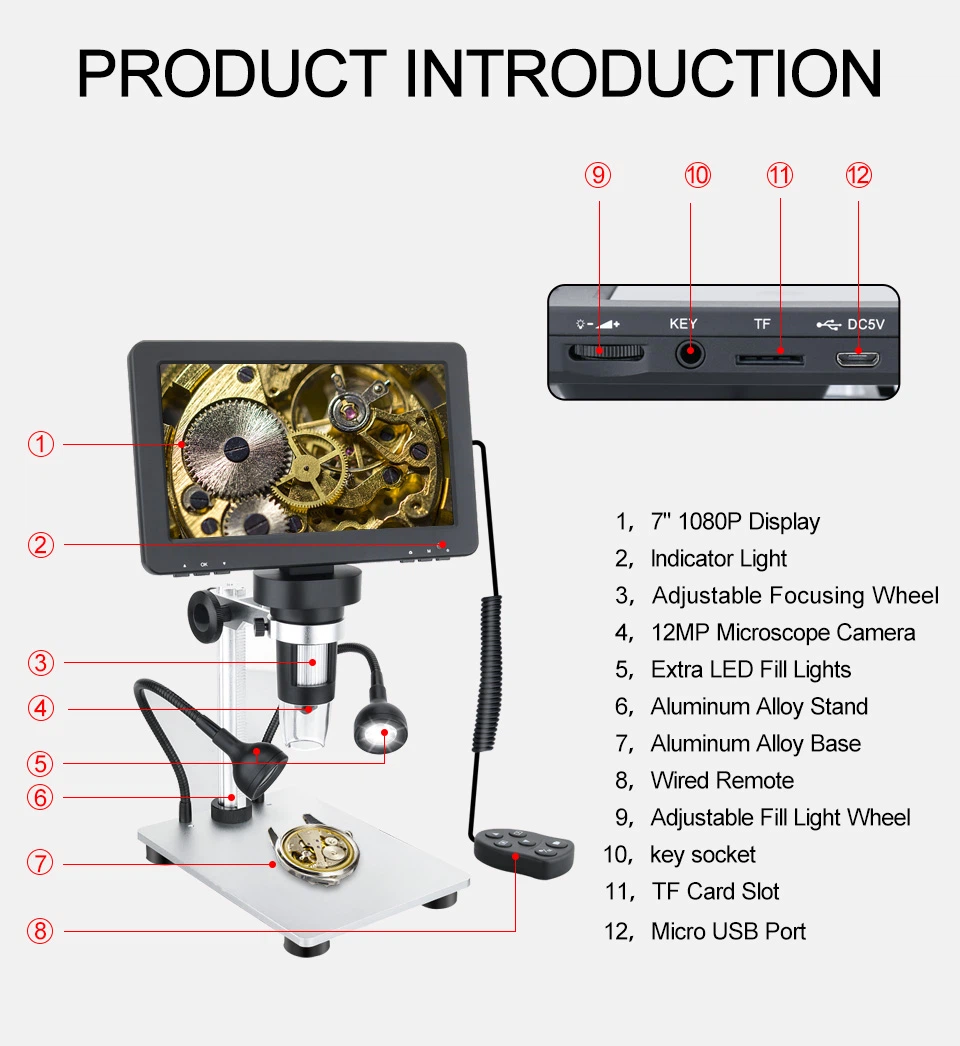
Objective lens group: such as 100x, 200x, 300x, 600x, etc.
Eyepiece group: such as 5x, 10x, 15x, 20x, etc.
Focusing handwheel: including coarse and fine adjustment
Stage: can move in any direction in a plane, easy to find the target area
sample
light source
color filter
2. Step method:
Turn on the light source
Rotate the coarse adjustment handwheel to pull the objective lens group and the stage to a safe distance
As a rule of thumb, change to a low magnification objective and a suitable eyepiece
Place the necessary sample on the stage
Adjust the pupil distance of the mirror
Move the sample through the stage, search the sample and target area, observe and select the target through the coarse handwheel
Change the appropriate high power objective and eyepiece, and focus carefully with the fine adjustment handwheel
Once you have a clear image, you can start your research and take pictures if necessary
After completing the work, turn off the light source and remove the sample. The objective lens group and eyepiece group must also be removed and stored in a special dry and cool place, such as a drying bottle.