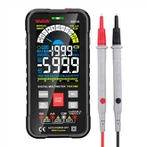
How to calculate the accuracy of a multimeter?
Accuracy depends on the error value included in the measurement. The accuracy specification is expressed as follows: "% of reading + % of span". In this formula, "% of reading" is proportional to reading, and "% of range" is the offset value. These specifications are developed for each measurement range.
If the accuracy does not meet the requirements of the measurement resolution, then the resolution has no effect on the accuracy. However, you can still use a multimeter to monitor small changes during the measurement.
Example: Suppose you want to measure a 10 Vdc signal with a 34401A multimeter with 1 year accuracy and 10V range, then the accuracy is: 0.0035 + 0.0005 = 10 x (0.0035 / 100) + 10 x (0.0005 / 100) = +/- 0.00040
therefore:
Measured value: 10.00000
Accuracy is: *+/-0.00040
Resolution is: 0.00001
Actual reading is between 9.9996 and 10.0004
The last two digits of the measurement include errors.
*Some models of multimeters use "ppm" instead of "% of reading" and "% of range". The value of ppm can be obtained by multiplying by 1/1,000,000 (= 10-6).
Example 1: If the error of 1 (V) is 10ppm, the actual error value is 1 x 10 x (1/1,000,000) = 0.00001 (V)
Example 2: If the error of 1 0 (V) is 5ppm, the actual error value is 10 x 5 x 10-6 = 50 u (V)
Accuracy specifications are defined under specific circumstances, such as ambient temperature changes and instrument settings (such as AUTO ZERO ON/OFF).