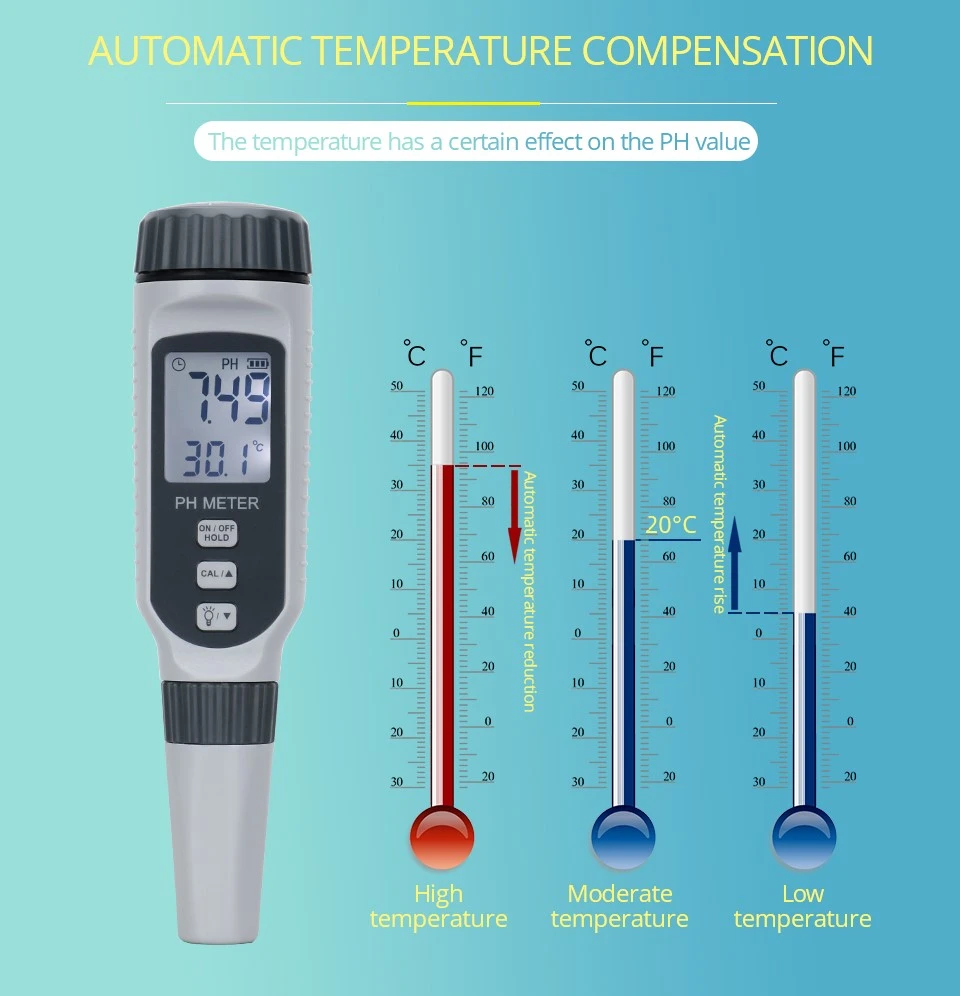
How to deal with pH meter Err malfunction
1. No response when turned on
Fault cause: 1) The circuit is not connected; 2) Unstable external voltage; 3) Instrument damage.
Exclusion method: 1) Check if the power supply has voltage output; 2) If there is no response when the instrument is powered on with an external stabilized power supply, check the output of the stabilized power supply, which should have a DC voltage of 9V; 3) Replace or repair according to regulations.
2. No display when turned on
Fault cause: 1) Mismatch of wiring potential between LCD screen and motherboard; 2) Poor contact of the connection wire between the motherboard and the LCD screen or damage to the instrument.
Exclusion method: 1) If there is backlight on the power on but no displayed numbers, adjust the potentiometer on the motherboard; 2) Replace or repair according to regulations.
3. Power on display error, with the word Err appearing
Reason for malfunction: Desktop or portable pH meters generally have a self checking function. When the instrument detects a problem with the storage chip, this message will be displayed.
Troubleshooting: Shut down, wait a moment, restart the pH meter multiple times. If the problem persists and the chip cannot be restored, please contact a professional engineer for repair.
Why is klcl used for pH meter electrode protection solution
To maintain the pH of the membrane constant.
The membrane of the pH electrode is made of potassium containing glass, with a saturated solution of KCl as the internal reference solution. After use, in order to achieve standard ion exchange on the glass membrane, it is necessary to soak the electrode in KCl, which can effectively prevent the loss of the reference solution, prolong the use time of the electrode, maintain its original pH potential balance, and ensure more accurate measurement. The protective solution for the H electrode is a 3mol/L KCl solution (KCL is a neutral solution).
The pH meter electrode protective solution is a liquid used to protect the pH meter electrode, mainly composed of preservatives and other components. The electrodes used in the laboratory are all composite electrodes, which have the advantages of being easy to use, not affected by oxidizing or reducing substances, and having a fast equilibrium speed.