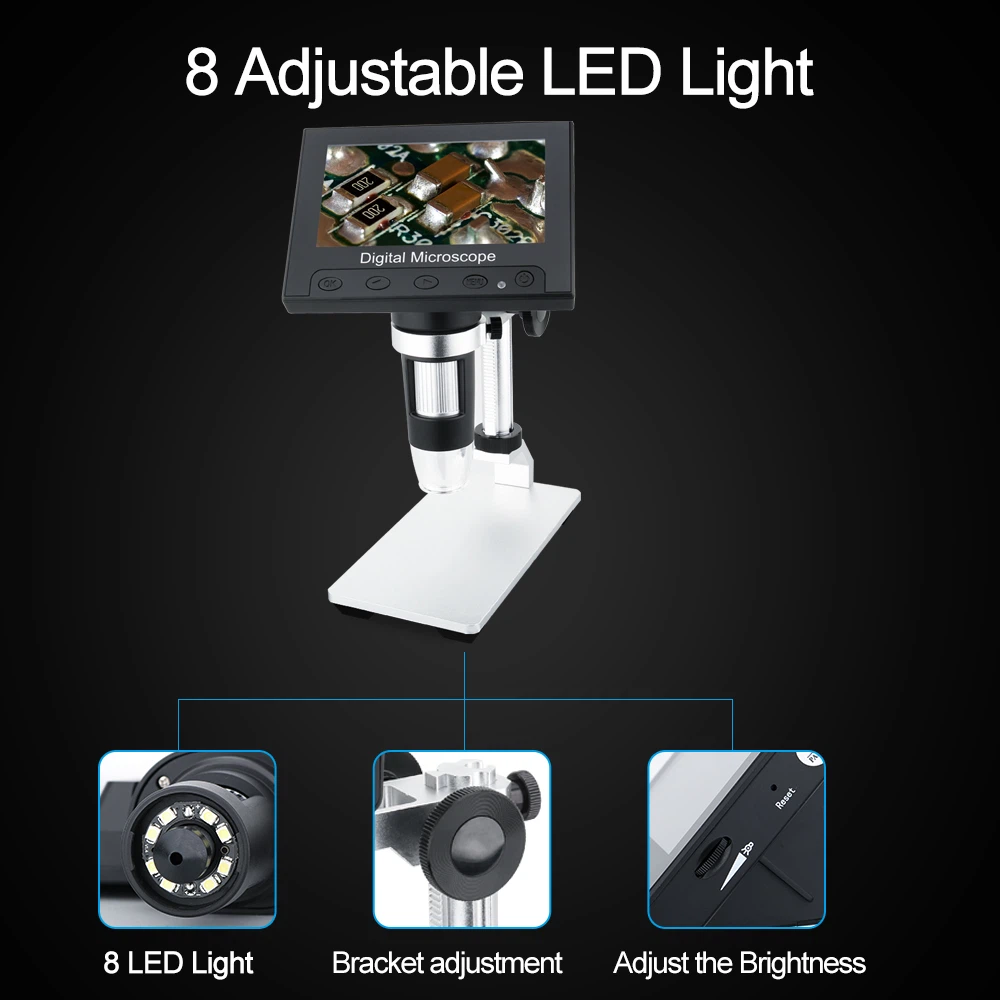
How to Distinguish Different Types of Microscopes
1. Biological microscopes use transmission illumination, which is generally used to observe transparent and semi transparent samples, and cannot be used to observe opaque objects. Metallographic microscopes, on the other hand, mainly use falling light illumination, with the light source emitted from the objective lens, and are mainly used to observe the surface of opaque samples. Of course, there are also metallographic microscopes with transmission illumination devices that can be used to observe transparent samples at the same time.
2. From the perspective of the objective lens, high-power objectives of biological microscopes take into account the thickness of the cover glass (0.17) and the thickness of the glass slide and culture vessel (1.2), so their objectives are usually marked as/0.17 (upright microscope) and/1.2 (inverted microscope). For upright biological microscopes below 10x, the objective lens is marked as/-, which means it can be ignored. This is to correct the influence of glass on light refraction, while the objective lens of metallographic microscopes is usually marked as/0.
The difference between biological microscope, stereomicroscope, and metallographic microscope. Stereoscopic microscope, also known as stereomicroscope, is mainly different from biological microscope as follows:
1, The working distance of stereomicroscopes is relatively large, usually up to 50mm or even 150mm; while the working distance range of biological microscopes for detecting objects rarely exceeds 20mm.
2, Stereoscopic microscopes can hold taller and thicker objects such as integrated circuit blocks, larger workpieces, screws, thicker objects, etc., while biological microscopes can only hold thin films, glass slides, etc.
3, The depth of field range of a stereo microscope is relatively large, reaching up to 10mm. By adjusting the focus ring, clear images can be seen over a considerable range; However, the biological microscope may not be able to see clearly by slightly rotating the focusing ring.
4, Stereoscopic microscopes can see three-dimensional images due to their wide depth of field. However, the magnification is relatively small, usually around 200 times for stereo microscopes; The maximum magnification of biological microscopes is generally around 2000 times, and the characteristic parameters of biological microscopes are exactly opposite to those of stereomicroscopes. So, the adaptation range of stereomicroscopes and biological microscopes is different, and the structure of the lens is also different.