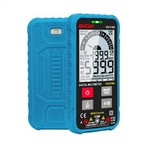
How to measure the pH value of groundwater with a pH meter? pH meter operating procedures
What is pH? PH is an abbreviation for the Latin word "Pondus hydrogeni" (Pondus=pressure, pressure hydrogenum=hydrogen), used to measure the activity of hydrogen ions in a substance. This activity is directly related to the acidity, neutrality, and alkalinity of aqueous solutions. Water is chemically neutral, but it is not without ions, and even chemically pure water has trace amounts of dissociation: strictly speaking, hydrogen nuclei do not exist in a free state before hydration with water molecules.
If there is an excess of hydrogen ions H+, the solution becomes acidic. Acid is a substance that can ionize hydrogen ions H+in aqueous solutions. Similarly, if OH - ions are ionized, the solution becomes alkaline. So, giving the H+value is sufficient to indicate the characteristics of the solution, whether it is acidic or alkaline. In order to avoid using this molecular concentration negative exponent for calculation, biologist Soernsen suggested in 1909 to replace this inconvenient value with a logarithm and define it as the "pH value". Mathematically, pH is defined as the commonly used logarithmic negative value of hydrogen ion concentration. That is, pH=- log [H+].
PH is one of the most important and frequently performed analysis items in water analysis, and is an important parameter for evaluating water quality. When water is contaminated, it may cause significant changes in pH value. When water contains a large amount of free carbon dioxide, it can significantly lower the pH value of the water.
This method uses a pH glass electrode as the indicator electrode and a saturated calomel electrode as the reference electrode, immersed in the measured solution to form the primary cell. At 25 ℃, each unit of pH value is equivalent to a 59.1mV change in electromotive force. For every 59.1mV change in electromotive force, the pH value of the solution changes by one unit. After positioning with a standard buffer solution, place the electrode into the sample to directly measure the pH value on the pH meter. The temperature difference can be corrected by the temperature compensation device on the instrument. The color, turbidity, colloidal substances, oxidants, reducing agents, and high salt content of the water sample do not interfere with the measurement. But in strong alkaline solutions, errors can occur when a large amount of sodium ions are present, resulting in lower readings.