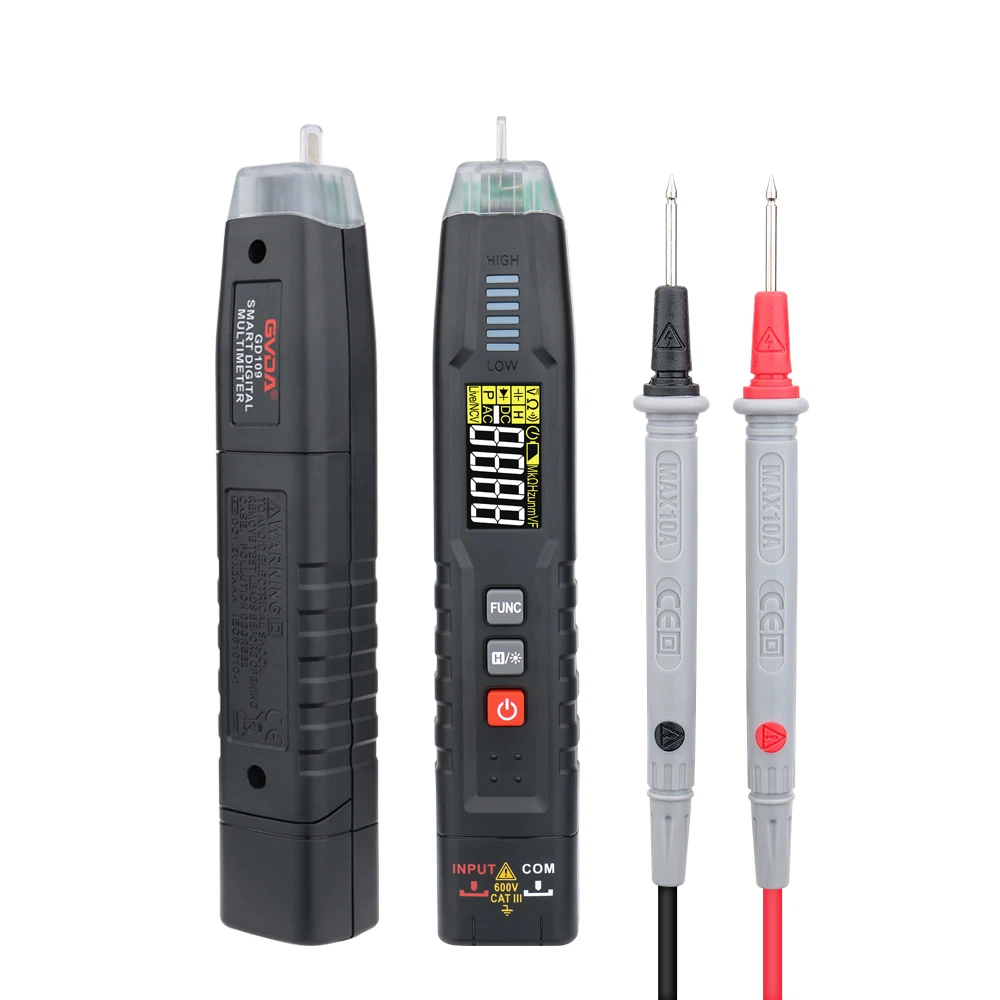
How to measure the quality of three-phase motors with a multimeter
First, use a multimeter to measure the DC resistance value of each winding of the motor. For three-phase motors, check that the resistance values of the three-phase windings are as balanced as possible. Generally, the resistance value error of the three-phase windings of motors with smaller power (below 2.2KW) cannot exceed 5Ω. Power comparison The resistance error of the three-phase windings of large motors cannot exceed 2 ohms. The three-phase motors have different winding resistances with different power levels (generally ranging from 1 to several hundred Ω. The greater the power, the smaller the DC resistance value of the windings. ).
The resistance of a single-phase motor is generally between a few Ω and a few kΩ, and it has only a main winding and a auxiliary winding. The main and auxiliary windings of a single-phase motor that can rotate forward and reverse have the same DC resistance value, and the auxiliary can only run in one direction. The resistance value of the winding is slightly larger than the resistance value of the main winding. For a single-phase motor using a short-circuit ring, only the main winding is actually connected to the 220v AC power supply.
Using a multimeter to measure the insulation resistance of the winding is not accurate enough, but some non-breakdown insulation resistance can also be roughly measured with a multimeter. Use the 200M range of the digital multimeter (RX10K range of the pointer multimeter) to measure one phase winding and the other two phase windings. Or the insulation resistance between the winding and the chassis, the DC resistance value is infinite or above several hundred megohms.
If the DC resistance value is relatively low, it proves that the winding insulation resistance is small, it may be damp and needs to be dried before operation. If the displayed resistance value is tens or 0, it proves that there is a short circuit between the windings and the windings, and between the windings and the chassis. It needs to be inspected and the fault can be eliminated before it can be put into operation.
1. Visual inspection to see if the motor has an obvious burnt smell and whether the terminals of the junction box are in good condition.
2. Turn the motor rotor by hand to see if the rotation is normal and if there is any abnormal noise.
3. Use a multimeter to measure parameters.
We know that motors have delta connection and star connection, but no matter which connection method is used, the measurement method is the same:
One is to measure the insulation to ground of each of the three phases.
(Of course, a multimeter can only measure the resistance to ground, because insulation is relative to voltage. To measure insulation, you still need to use a megger or an insulation resistance tester. For convenience of description, it is still called insulation).
The second is to measure the phase insulation between two of the three phases.
The third is to use the resistance range of the multimeter to test the DC resistance value of the three-phase winding. (DC resistance is generally measured more accurately with a DC resistance tester or Wheatstone bridge, because the DC resistance value is generally measured to be very small, usually around 0.2 ohms. If there is no relevant instrument, a multimeter can also be used instead.)
Generally speaking, the measured insulation resistance should not be too small, generally at least 0.5 megohms. The three measured insulation resistance values to ground should be equivalent, and the three phase-to-phase insulation resistance values should be equivalent. The three DC resistor values must also be equivalent.