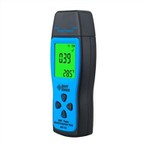
How to Read Measurements on a Digital Multimeter
1, Bit count and resolution: the ability to display details
The number of digits on the screen of a digital multimeter represents the measurement resolution (the smallest quantifiable detail), and the more digits, the higher the resolution.
The special meaning of half digit: Half digit is the most significant digit and can only display "0" or "1". For example:
3 1/2 digit multimeter: maximum display of "1999", corresponding to 2000 resolution counts;
4 1/2 digit multimeter: maximum display of "19999", corresponding to 20000 resolution counts;
Desktop multimeters are often 5 and a half position, 6 and a half position, or even 8 and a half position (high-performance models used in metrology laboratories).
Resolution calculation: Resolution=range ÷ total count. For example, at a range of 1V, the resolution of a 6/4-digit multimeter (counting 1999999) is 1V ÷ 2000000=500nV, where the last digit represents 500nV.
2, The difference between accuracy and resolution
Resolution: measures the level of detail displayed (such as the ability to distinguish a difference of 500nV at a range of 1V with 6 and a half bits);
Accuracy: measures the degree of closeness between the measured value and the true value (for example, if the accuracy of a multimeter is ± 0.01%, it means that the deviation between the reading and the true value is within this range).
There is no direct correlation between the two, for example, if the accuracy of a high-resolution 6/2 meter is poor, its reading reliability may not be higher than that of a high-precision 5/2 meter.
3, The influence of measurement speed on resolution
There is a trade-off between measurement speed (ADC sampling rate) and resolution:
The faster the speed, the lower the resolution may be (fast sampling is difficult to capture subtle changes);
High precision measurement requires reducing speed to ensure resolution.
For example, the 34470A 7-inch multimeter from DeTech has a lower resolution in high-speed mode than in slow mode.
4, Reading Interpretation Example
Taking the display of "1.234568" on a 6 1/2 multimeter in a 1V range as an example:
The total count is 2000000, with a resolution of 500nV;
The last digit "8" in the reading represents 8 × 500nV=4 μ V;
By combining precision indicators (such as ± 0.002%), the range of true values can be determined.
In short, when reading the results of a digital multimeter, it is necessary to first determine the resolution corresponding to the number of digits, and then combine the accuracy indicators to judge the credibility of the reading. At the same time, attention should be paid to the impact of measurement speed on the details of the results.