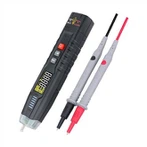
How to use a megohmmeter to measure insulation resistance and what preparations should be made before measurement
A megohmmeter is convenient and reliable for measuring insulation resistance, but if not used, it can bring unnecessary errors to the measurement. In addition, the megohmmeter generates high voltage during operation, and the measurement object is electrical equipment. Improper operation can cause personal or equipment accidents.
Therefore, it is necessary to use a megohmmeter correctly for insulation resistance measurement, and the following preparations must be made before use:
1. The surface of the measured object should be clean to reduce contact resistance and ensure the accuracy of the measurement results.
2. When using a megohmmeter, it should be placed in a stable and secure place, and away from large external current conductors and external magnetic fields.
3. For equipment that may induce high voltage, this possibility must be eliminated before measurements can be made.
4. Before measurement, the power supply of the tested equipment must be cut off and the equipment must be short circuited to ground for discharge. It is never allowed to measure the equipment with electricity to ensure personal and equipment safety.
5. Before measurement, check whether the megohmmeter is in normal working condition, mainly checking its "0" and "∞" points. Shake the handle to reach the rated speed of the motor. The megohmmeter should indicate the "0" position during a short circuit and the "∞" position during an open circuit.
After completing the above preparations, measurements can now begin. Pay attention to the correct wiring of the megohmmeter during measurement to avoid unnecessary errors or even errors.
There are three wiring terminals for a megohmmeter: "L" refers to the line terminal; 'E' represents the ground terminal; The "G" refers to the shielding end, also known as the protective ring. Usually, the measured insulation resistance is connected between the "L" and "E" ends. However, when the surface leakage of the tested insulator is severe, the shielding ring or the part that does not need to be measured of the tested object must be connected to the "G" end. In this way, the leakage current flows directly back to the negative end of the generator through the shielding terminal "G" to form a circuit, instead of flowing through the measuring mechanism of the megohmmeter, fundamentally eliminating the impact of surface leakage current.
When using a megohmmeter to measure the insulation resistance of electrical equipment, it is necessary to note that the "L" and "E" terminals cannot be connected in reverse. The correct connection method is to connect the "L" line terminal to the conductor of the tested equipment, the "E" ground terminal to the equipment shell, and the "G" shielding terminal to the insulation part of the tested equipment. Once "L" and "E" are connected in the opposite direction, the leakage current flowing through the insulation body and surface flows through the casing to the ground, and then flows into the measurement coil through "L", causing "G" to lose its shielding effect and causing significant measurement errors.
In addition, because the insulation degree between the internal leads of the "E" end and the casing is lower than that between the "L" end and the casing, when the "L" and "E" are connected in reverse, the insulation resistance of "E" to the ground is parallel to the measured insulation resistance, resulting in a smaller measurement result and causing significant errors in the measurement. When the megohmmeter is used on the ground and the correct wiring method is used, the insulation resistance between the "E" end and the instrument casing and the casing to the ground is equivalent to a short circuit, It will not cause errors.
When measuring the insulation resistance between the cable core and the outer surface, it is necessary to connect the shielding terminal button "G" well, because when the air humidity is high or the cable insulation surface is not clean, the surface leakage current will be large. To prevent the impact of the measured object on its internal insulation measurement due to leakage, a metal shielding ring is generally added to the outer surface of the cable and connected to the "G" end of the megohmmeter.
In short, only by using a megohmmeter correctly can the insulation resistance of electrical equipment be accurately measured, otherwise the accuracy and reliability of the measurement will be lost, laying hidden dangers for electrical safety.