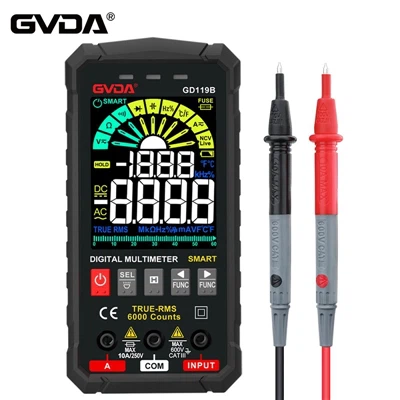
How to use a multimeter to determine motor speed
Ordinary three-phase squirrel cage motors have two speeds: one is the synchronous speed N1. The so-called synchronous speed is the rotating magnetic field of the motor.
The rotational speed has a strict relationship with the number of magnetic pole pairs of the motor, that is
n1——synchronous speed, rpm;
J——frequency of current, cycles/second;
P——The number of magnetic pole pairs of the motor.
The second is the asynchronous speed, which is the speed of the motor shaft. When an electric motor drives production machinery, the speed of the motor shaft is
The rotational speed of the rotating magnetic field is slightly lower, but the difference is almost the same. For example, for a pair of pole motors, the speed of the motor wheel is 2950 rpm, for a two-pole motor it is 1430 rpm, and for a three-pole motor it is 920 rpm. Based on the above principle, a multimeter can be used to determine the number of magnetic poles of the motor, and then determine the speed of the motor;
The method of using a multimeter to determine the number of magnetic pole pairs of the motor is as follows:
1. Fold off the six wire ends of the motor;
2. Use the ohm dial of the multimeter to find any phase of the three-phase winding, such as terminals 1 to 2 in the figure;
3. Set the milliamp setting of the multimeter to the smallest setting, and connect its two wires across terminals 1 to 2;
4. Slowly rotate the motor shaft and observe the change of the multimeter pointer. If the shaft rotates once and the pointer swings once, it means that the current changes for one cycle, which is a pair of magnetic poles; if it swings twice, it is two pairs of magnetic poles; if it swings three times, it is three pairs of magnetic poles.