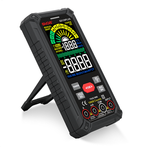
How to use a multimeter to measure and determine the pin and model
1. Find the base: Place the digital multimeter in diode mode, connect the red probe to either pin, and use the black probe to sequentially contact the other two pins. If both displayed values are less than 1V or both display the overflow symbol 1, then the pin connected to the red probe is the base b. If the displayed value is less than 1V in two tests and the overflow symbol 1 is displayed in the other test, it indicates that the pin connected to the red probe is not the base. Then use another pin to re measure and find the base
2. Determine the tube type, place the digital multimeter in diode mode, connect the red probe to the base, and use a black probe to touch the other two pins in sequence. If both display 0.5V to 0.8V, the tested tube belongs to NPN type. If overflow symbol 1 is displayed twice, it indicates that the tested tube belongs to PNP type.
3. Distinguish between collector C and emitter e. Taking NPN transistor as an example, place the digital multimeter in HFE mode and use PNP socket. Insert the base B into the B hole, and insert the remaining 2 pins into the C and E holes respectively. If the measured HFE is in the range of tens to hundreds, it indicates that the tube is connected normally and has strong amplification capability. At this time, the collector C is inserted into the C hole and the emitter E is inserted into the E hole. If the measured HFE value is only a few or a dozen, it indicates that the collector c and emitter e of the tested tube are inserted in reverse. At this time, the C hole is connected to the emitter e, and the E hole is connected to the collector c. In order to make the test results more reliable, the base b can be fixed in the B hole, and the collector c and emitter e can be swapped and retested twice, with the larger displayed value as the standard. The pin connected to the C hole is the collector c, and the pin connected to the E hole is the emitter e.
4. Testing is good or bad. Taking NPN type as an example. Open circuit the base b and measure the resistance between the c and e poles. Connect the red pen of the multimeter to the emitter and the black pen to the collector. If the resistance value is above tens of thousands of ohms, it indicates that the penetration current is small and the tube can work normally. If the resistance between the c and e poles is small, the measuring tube will not work stably and cannot be used in circuits with high technical specifications. If the measured resistance value is approximately 0, then the tube has been broken down. If the resistance value is infinite, it indicates that there is an open circuit inside the tube.