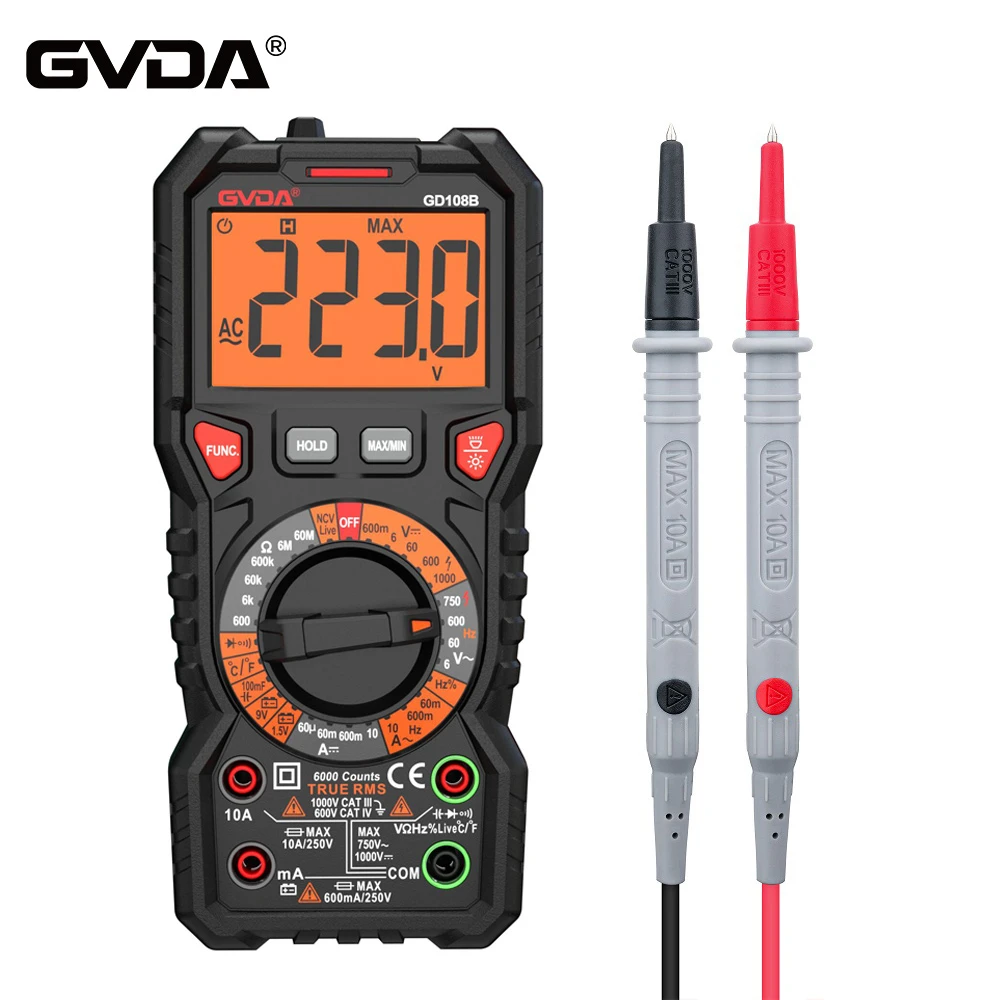
How to use a multimeter to measure the current of a charging current meter
To measure AC and DC currents using a multimeter, the current setting of the multimeter must be set to either AC or DC, and the measurement should be carried out by connecting the multimeter in series with the circuit.
For a pointer multimeter, its red probe needs to be connected to the positive terminal of the charger output, and its black probe needs to be connected to the charged electrical load. If a digital multimeter is used to measure the current in a charging circuit, its red and black probes can measure the value of AC or DC current in the circuit even if they are reversed, except that there is a - (- negative sign) in front of the display on the digital multimeter.
For measuring relatively small AC or DC charging currents, the current level of the multimeter can be set to 500mA. If measuring a charging current exceeding 500mA, it is necessary to set the pointer multimeter or digital multimeter to the 5A position of the pointer multimeter (except for a few models that have a 10A position, the MF47 multimeter usually only has a 5A DC current position), while the digital multimeter has an AC or DC current position of 10A or 20A.
Because the digital multimeter I usually use has automatic gear shifting, I can only use it. Other digital multimeters only require shifting the gear to point to 20A. At this point, insert the red probe into the 10th gear, and if the black probe is still missing in the original COM socket, it is sufficient.
It should be noted that batteries generally use constant voltage charging method for fast charging. Due to the constant charging voltage, the charging current at both ends of the battery is relatively low, and the starting charging current will be large. As the voltage increases, the charging current at both ends of the battery will gradually decrease. Therefore, the charging current measured at different charging time periods is different.
There is a significant difference between lithium battery charging and battery charging. In order to protect the maximum efficiency and usage time of lithium batteries, they can generally be divided into four stages: pre charging, fast charging, make-up charging, and trickle charging. So, the charging current at any stage will also vary.
There are clamp type multimeters and ordinary multimeters. The clamp type is simple. Set the meter to the current mode, place the tested wire into the clamp ring, and read the data. Ordinary multimeters need to be connected in series to the circuit. Pay attention to the range of the meter and be careful not to burn it out. This type of meter can measure currents that are not very large and is not suitable for measuring high current circuits.
Simply connect a multimeter to the charging circuit, select DC2A for fast charging and DC500mA for slow charging. Or buy a dedicated test question for mobile phone charging, which can simultaneously detect charging voltage and battery, with dual LED display, priced at around 25 yuan, and both input and output are USI3 interfaces.
In addition, a 1 ohm resistor can be connected in series in the circuit, and the voltage across the resistor can be directly measured. The voltage value is the current value. Due to the insertion of resistors causing a decrease in overall current, the actual current may be slightly higher than the measured value. When 讠=v/R and R=1,
讠=v).
Set the multimeter to the corresponding current range. If you don't know, try to use the highest range. Generally, the highest range of a multimeter is 10A or 20A. You need to unplug the red wire and plug it into a dedicated socket. Connect one end of the charger to the battery, and connect one of the two multimeter probes to the other end of the charger and the other to the remaining end of the battery. A digital multimeter doesn't matter. If it's a pointer multimeter, you must pay attention to polarity. The red probe must be connected to the positive terminal of the charger or the negative terminal of the battery, and the black probe must be connected to the negative terminal of the charger or the positive terminal of the battery. It depends on which end you connect to.
The output current of a typical 12V charger will not exceed 8A, while a better one will have a larger output current. The multimeter probe wire is too thin and not suitable for serial detection of charger output current. It is best to use non-contact measuring instruments.
The multimeter has two current levels (mA and A). According to the instructions, insert the red and black probes into the holes, turn the multimeter to the corresponding A level, and then connect the red and black probes in series to the current circuit for measurement.