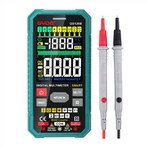
How to use a multimeter to measure the power of a heating tube
The heating tube can be regarded as a purely resistive load, and the current flowing through the heating tube is pure active current. Use a clamp multimeter with an AC current measurement function to measure the current when the heating tube is working. The value obtained by multiplying the current value by the rated voltage of the heating tube is the power (wattage) of the heating tube.
For example, the rated voltage of an electric heating tube is 220 volts, and the measured current is about 2 amps, then the power of this heating tube is about 440 watts. If the rated voltage of the heating tube is 380 volts and the measured current is about 1 A, then the power of the heating tube is about 400 watts.
One thing to pay attention to here is the rated voltage of the heating tube. If a heating tube with a rated voltage of 220 volts is connected to a voltage of 380 volts, the heating wire will be burned out quickly because the voltage is too high. On the contrary, if a heating tube with a rated voltage of 380 volts is connected to a voltage of 220 volts, it will not reach the rated power because it cannot reach the rated voltage.
In actual production, 220-volt and 380-volt electric heating tubes are often used. When ordering electric heating tubes, it is best to let the manufacturer stamp the rated voltage on the heating tube shell with a steel stamp. To avoid confusion.
How to use a multimeter to test the quality of screw bulbs? How to use a multimeter to test the quality of LED lights?
If it is an ordinary old-fashioned incandescent lamp, just use the resistance setting of the multimeter to measure it, and both analog multimeters and digital ones can be used. The digital meter uses the 2kΩ level, and the pointer meter uses the Rx1 or Rx10 level. Since what is measured at this time is the cold resistance of the filament, the resistance value is in the range of tens to hundreds of Ω (the greater the wattage, the smaller the resistance value).
If you measure an LED bulb, it can only reflect whether the rectifier and filter part is normal. It cannot be 100% sure of the overall quality of the bulb. It is best to use a pointer multimeter to measure it (the output voltage of the digital meter is too low and sometimes the data cannot be measured).
Set the pointer to the Rx10K position and directly measure the two contacts of the bulb. Due to the charging effect of the filter capacitor in the lamp, the pointer at this time is very similar to the state when measuring the capacitor. After swinging for a while and gradually returning, it can be determined that the rectifier and filter part is normal. In addition, you can also turn on the light bulb and use the diode setting of the digital meter or the Rx10K setting of the pointer meter to measure the quality of the LED lamp beads one by one. However, there is now a small integrated lamp bead with a high forward conduction voltage, some even as high as 30V, which cannot be measured with any multimeter.