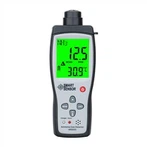
How to use a multimeter to measure the speed and number of poles of an electric motor
If the motor does not have a nameplate and a tachometer, a multimeter can be used to determine the motor speed without disassembling the motor.
Connect the minimum milliampere range of a multimeter to the first and last ends of a winding that has already been determined. Slowly and uniformly rotate the rotor once, and observe how many times the multimeter pointer swings. If it swings once, it indicates that the current changes positively and negatively for one cycle, indicating that it is a 2-pole motor. For the same reason, swing twice to determine it is a 4-pole motor, swing three times to determine it is a 6-pole motor, and so on.
By determining the number of poles of the motor, one can determine its approximate speed (slightly lower than the synchronous speed). The relationship between the synchronous speed of an electric motor and the number of magnetic poles can be calculated as follows when the power frequency is 50Hz: the second pole is 3000r/min, the fourth pole is 1500r/min, and the sixth pole is 1000r/min.
stay
During operation, the multimeter probe should maintain good contact with the terminal. Otherwise, during the process of rotating the rotor, the pointer will swing and the result cannot be determined.
How to use a multimeter to measure cable break points
When there is a broken wire fault inside a cable or cable, the exact location of the broken wire is difficult to determine due to the wrapping of the external insulation skin. Using a digital multimeter can easily solve this problem.
Specific method: Connect one end of the broken wire (cable) to the live wire of 220V mains power, and suspend the other end in the air. Pull the digital multimeter to the AC2V position, starting from the live wire connection end of the wire (cable), hold the tip of the black probe with one hand, and slowly move the red probe along the insulation of the wire with the other hand. At this time, the voltage value displayed on the display screen is about 0.445V. When the red probe moves to a certain position, the voltage displayed on the display screen suddenly drops to a few tens of volts (about one tenth of the original voltage), and about 15cm forward (from the end of the live wire connection) from that position is where the wire (cable) breakpoint is located.