How to use an anemometer
1. Before use, observe whether the pointer of the meter points to the zero point. If there is any deviation, you can gently adjust the mechanical adjustment screw of the meter to make the pointer return to the zero point;
2. Put the calibration switch in the off position;
3. Insert the plug of the measuring rod into the socket, place the measuring rod vertically upward, press the screw plug to seal the probe, set the "calibration switch" to the full-scale position, and slowly adjust the "full-scale adjustment" knob so that the pointer of the meter points at full scale. degree position;
4. Set the "calibration switch" to "zero position", and slowly adjust the two knobs of "coarse adjustment" and "fine adjustment", so that the pointer of the meter points to the zero position
5. After the above steps, gently pull the screw plug to expose the measuring rod probe (the length can be selected as needed), and make the red dot on the probe face the wind direction. measured wind speed;
6. After measuring for a few minutes (about 10 minutes), the above steps 3 and 4 must be repeated once to standardize the current in the meter
7. After the test, the "calibration switch" should be placed in the off position.
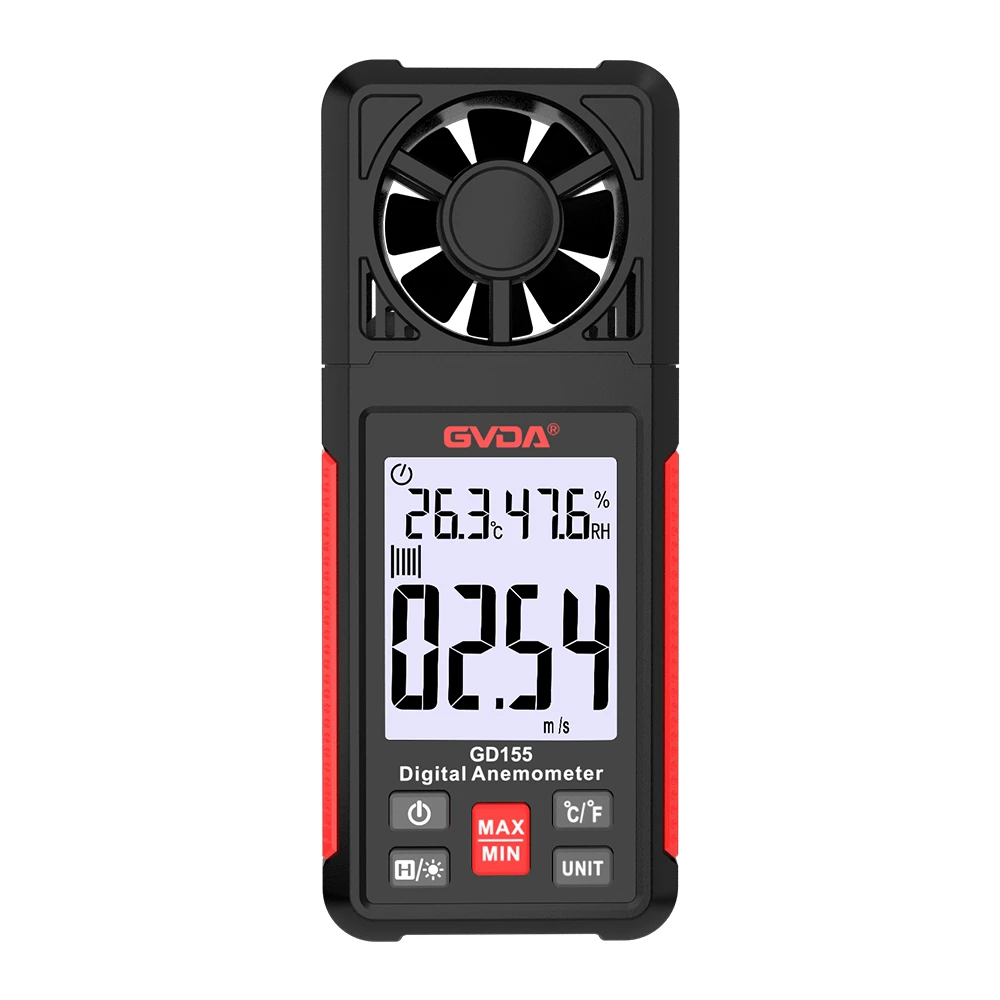
An anemometer is a speed measuring instrument that converts the flow velocity signal into an electrical signal, and can also measure the temperature or density of the fluid. The principle is that a thin metal wire (called a hot wire) that is heated by electricity is placed in the air flow, and the heat dissipation of the hot wire in the air flow is related to the flow rate, and the heat dissipation causes the temperature change of the hot wire to cause the resistance change, and the flow rate signal is converted into electric signal. It has two working modes: ①Constant flow. The current passing through the hot wire remains unchanged. When the temperature changes, the resistance of the hot wire changes, so the voltage at both ends changes, thereby measuring the flow rate; ② Constant temperature type. The temperature of the hot wire is kept constant, such as 150°C, and the flow rate can be measured according to the current required to be applied. The constant temperature type is more widely used than the constant flow type. The length of the hot wire is generally in the range of 0.5 to 2 mm, the diameter is in the range of 1 to 10 microns, and the material is platinum, tungsten or platinum-rhodium alloy. If a very thin (thickness less than 0.1 micron) metal film is used to replace the metal wire, it is a hot film anemometer. In addition to the ordinary single-wire type, the hot wire can also be a combined two-wire type or three-wire type to measure the velocity components in all directions. The electrical signal output from the hot wire is amplified, compensated and digitized and then input into the computer, which can improve the measurement accuracy, automatically complete the data post-processing process, and expand the speed measurement functions, such as simultaneous completion of instantaneous value and time average value, combined speed and sub-speed, turbulence degree and other turbulence parameters. Compared with the pitot tube, the hot-wire anemometer has the advantages of small probe size and little interference to the flow field; fast response, can measure unsteady flow velocity; can measure very low speed (eg as low as 0.3 m/s).