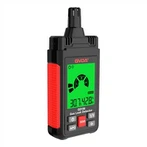
How to use clamp ammeter and insulation resistance meter
Clamp meters can measure AC and DC currents on low-voltage lines without interrupting the load operation.
1. The clamp meter made of electromagnetic current transformer can only measure AC current, not DC current
2. The clamp meter made of Hall current sensor can measure AC and DC current.
Insulation resistance tester (megger/megger).
Insulation resistance is an important indicator in equipment safety requirements testing. It can judge whether the insulator is complete enough and whether the surface of the insulator is polluted. By measuring the insulation resistance of the equipment, it can be found in time that the equipment is generally affected by moisture, insulation deterioration and insulation breakdown.
Megger, also known as megohmmeter, is an instrument used to measure the insulation resistance and high-value resistance of the equipment under test. terminal, G: shielding terminal), its purpose is to test the insulation condition of the circuit or electrical equipment. The usage and precautions are as follows:
1. First, choose a megger that is compatible with the voltage level of the component under test. For lines or electrical equipment that are 500V or below, you should use a 500V or 1000V megger. For lines or electrical equipment above 500V, a 1000V or 2500V megger should be used.
2. When testing the insulation of high-voltage equipment with a megger, it should be carried out by two people.
3. Before the measurement, the power supply of the tested circuit or electrical equipment must be completely disconnected, that is, it is not allowed to measure the insulation resistance with power on. And it can only be carried out after confirming that no one is working on the line or electrical equipment.
4. The meter wires used by the meter must be insulated wires, and twisted insulated wires should not be used. The ends of the meter wires should have insulating sheaths; the line terminal "L" of the meter should be connected to the measured phase of the equipment. , The ground terminal "E" should be connected to the equipment shell and the non-measured phase of the equipment, and the shield terminal "G" should be connected to the protection ring or the cable insulation sheath to reduce the error caused by the leakage current of the insulation surface.
5. Open-circuit calibration should be performed on the megger before measurement. When the "L" end and "E" end of the shaker meter are empty, shake the shaker meter, and its pointer should point to "∞"; when the "L" end and "E" end of the shaker meter are short-circuited, the pointer of the shaker meter should point to "0" ". It means that the shaker function is good and can be used.
6. Before testing, the tested circuit or electrical equipment must be grounded and discharged. When testing the line, you must obtain the permission of the other party before proceeding.
7. When measuring, it is advisable to shake the handle at a uniform speed of 120r/min; after maintaining a stable speed for 1min, take the reading to avoid the influence of the absorbed current.
8. During the test, both hands must not touch the two wires at the same time.
9. After the test, the stitches should be removed first, and then stop shaking the watch. In order to prevent electrical equipment from reversely charging the megger and causing damage to the megger.
10. After the test is completed, the test object is discharged to the ground in time.
11. During lightning, it is strictly forbidden to test the line insulation.