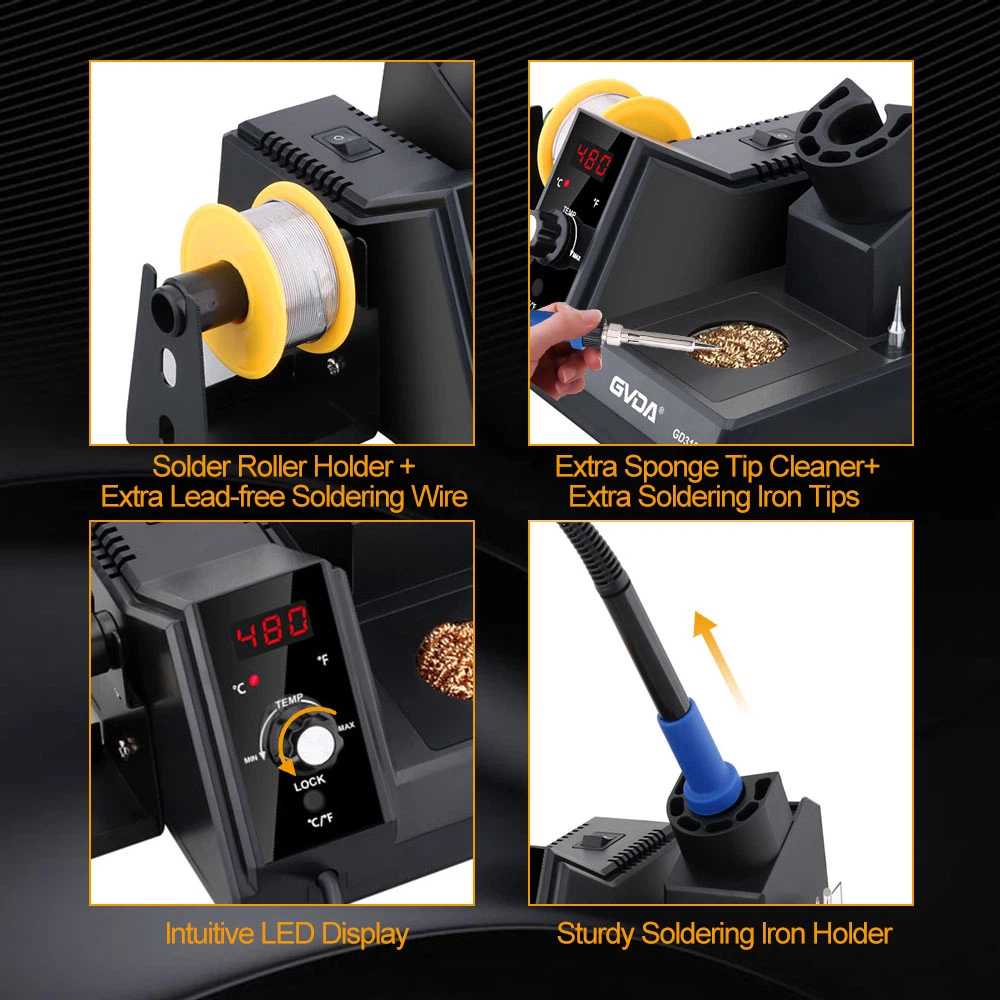
1. Before using the new soldering iron,
Use fine sandpaper to polish the soldering iron tip, then heat it up, energize it, dip it in rosin, and touch the tip of the tip with the solder wire. This will evenly plate the soldering iron tip with tin, making soldering easier and preventing the surface from oxidizing. The surface oxide of an old soldering iron tip that has been extensively oxidized and blackened can be cleaned using a steel file to reveal the metallic shine, and it must then be tinned once more before it can be used.
When utilizing the electric soldering iron, which runs on a 220V AC power source, great care should be paid to safety. The following things need to be done with care:
For the electrical soldering iron plug, a three-pole plug is recommended, and the shell needs to be securely grounded.
Check the power plug and power cable for damage before using them, and make sure the soldering iron's tip is not loose.
Don't hit the soldering iron too hard when using it. When there is too much solder on the soldering iron tip, you can brush it off with a towel to keep it from falling.
The soldering iron shouldn't be used in random places while soldering. It ought to be set on the soldering iron stand when not soldering. To avoid accidents burning the insulating layer, the power cord should not be positioned on the soldering iron head.
After use, cut off the power in time, unplug the power plug to cool down, and then return the soldering iron to the toolbox.
2. Solder and flux
When soldering, solder and flux are also required.
Soldering: Soldering electronic components, generally using rosin core solder wire, this kind of solder wire has a low melting point and contains rosin flux, which is very convenient to use.
Flux: A commonly used flux is rosin or rosin (dissolving rosin in alcohol). The use of flux can help to remove oxides on the metal surface, which is good for soldering and protects the tip of the soldering iron. Solder paste can also be used when soldering larger components or wires, but it is corrosive to a certain extent, and the residue should be removed in time after soldering.
3. Auxiliary tools
In order to facilitate the welding operation, needle-nose pliers, offset pliers, tweezers and knives are often used as auxiliary tools, and you should learn to use these tools correctly. Needle-nose pliers, offset pliers, tweezers, knife.
How to use an electric soldering iron - pre-soldering treatment
Before soldering, pre-soldering should be performed on the component pins or the soldered parts of the circuit board:
Removal of oxide layer from solder joints
A knife can be made of a broken saw blade to scrape off the oxide layer on the surface of the metal lead to expose the metal luster to the lead.
The printed circuit board can be coated with a layer of rosin alcohol solution after polishing the copper foil with spun yarn paper.
Component tinned
Tin the scraped leads. The lead can be dipped in the rosin alcohol solution, then press the tip of a hot soldering iron with tin on the lead and turn the lead. The lead wire can be evenly coated with a thin layer of tin. Before the wire is welded, the insulating sheath should be stripped off, and then the above two treatments can be carried out before formal welding. Twisted together first, then tinned. Scrape off the oxide layer and apply a layer of tin evenly.