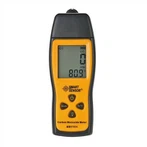
How to use ultrasonic thickness gauge correctly?
The ultrasonic thickness gauge measures thickness based on the principle of ultrasonic pulse reflection. When the ultrasonic pulse emitted by the probe reaches the material interface through the object being measured, the pulse is reflected back to the probe, and is determined by accurately measuring the time it takes for the ultrasonic wave to propagate in the material. The thickness of the material being measured. This principle can be used to measure various materials that can allow ultrasonic waves to propagate inside them at a constant speed.
Thickness gauges designed based on this principle can accurately measure various plates and various processed parts. They can also monitor various pipes and pressure vessels in production equipment to monitor their degree of thinning after being corroded during use. , can be widely used in petroleum, chemical industry, metallurgy, shipbuilding, aviation, aerospace and other fields.
1. General measurement methods
(1) Use the probe to measure the thickness twice at one point. The split surfaces of the probes in the two measurements should be 90° to each other. The smaller value is the thickness of the workpiece to be measured.
(2) 30mm multi-point measurement method: When the measurement value is unstable, take one measurement point as the center and conduct multiple measurements within a circle with a diameter of approximately 30mm, and take the minimum value as the thickness value of the workpiece being measured.
2. Precise measurement method
Increase the number of measurements around the specified measurement points, and the thickness changes are represented by isopach lines.
3. Continuous measurement method
Use single-point measurement method to measure continuously along the designated route, with intervals no larger than 5mm.
4. Grid measurement method
Draw a grid in the designated area and measure and record the thickness at each point. This method is widely used in high-pressure equipment and stainless steel lining corrosion monitoring.