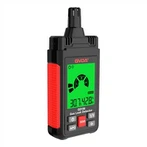
Illuminance meters' measurement units and circumstances of use
Units of illuminance meters
Many customers will say that if I want to buy a lux meter, they will naturally ask what the unit of the lux meter is! Now briefly introduce the illuminance. Illuminance is a unit that reflects the intensity of light. Its physical meaning is the luminous flux irradiated on a unit area. The unit of illuminance is the number of lumens (Lm) per square meter, also called Lux (Lux): 1Lux=1Lm/m2. It can be seen from the above formula that Lm is the unit of luminous flux, which is defined as the amount of light radiated by the surface area of 1/60 square meters of pure platinum within a solid angle of 1 steradian at the melting temperature (about 1770°C).
The above explanation of the illuminance unit seems to be very theoretical, and it is generally difficult to understand. In order to have a more perceptual understanding of the amount of illuminance, let me illustrate with an example. A 100W incandescent lamp emits a total luminous flux of about 1200Lm. If the luminous flux is assumed to be evenly distributed on a hemispherical surface, the illuminance values at 1m and 5m away from the light source can be obtained according to the following steps: The area of a hemisphere with a radius of 1m is 2π×12=6.28 m2, and the illuminance value at 1m away from the light source is: .28 m2=191Lux. Similarly, the area of a hemisphere with a radius of 5m is: 2π×52=157 m2, and the illuminance value at a distance of 5m from the light source is: 1200Lm/157 m2=7.64Lux.
General conditions: In summer, it is about 100,000LUX in the sun; on cloudy days, the outdoor illuminance is 10,000LUX; indoor daylight illumination is 100LUX; our illuminance on the tabletop 60cm away from the 60W desk lamp is 300LUX; the illuminance of the TV live broadcast room is 1000LUX; ~15LUX.