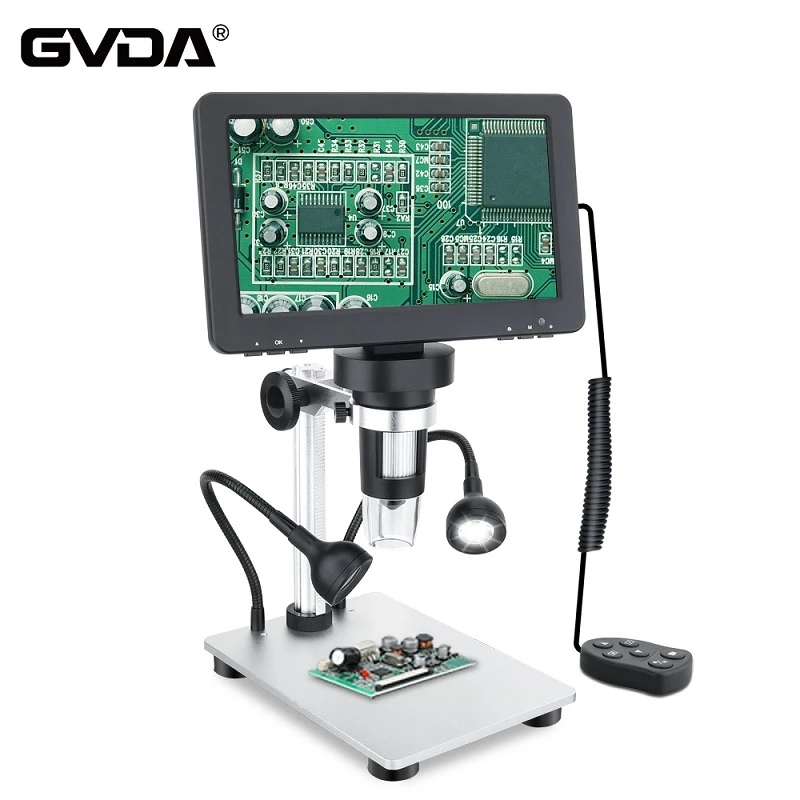
Important optical technical parameters of the microscope
In microscopic inspection, people always hope to have a clear and bright ideal image, which requires the optical technical parameters of the microscope to meet certain standards, and requires that when using it, it must be coordinated according to the purpose of microscopic inspection and the actual situation The relationship between the parameters. Only in this way can we give full play to the proper performance of the microscope and obtain satisfactory microscopic inspection results.
The optical technical parameters of the microscope include: numerical aperture, resolution, magnification, depth of focus, width of field of view, poor coverage, working distance, etc. These parameters are not all the higher the better, they are interrelated and restrict each other, when using, the relationship between the parameters should be coordinated according to the purpose of the microscope inspection and the actual situation, but the resolution should prevail .
1. Numerical aperture
Numerical aperture is abbreviated as NA. Numerical aperture is the main technical parameter of objective lens and condenser lens, and it is an important symbol to judge the performance of both (especially for objective lens). The size of its numerical value is respectively marked on the casing of the objective lens and condenser lens.
Numerical aperture (NA) is the product of the refractive index (n) of the medium between the front lens of the objective lens and the object to be inspected and the sine of the half of the aperture angle (u). The formula is as follows: NA=nsinu/2
Aperture angle, also known as "mirror mouth angle", is the angle formed by the object point on the optical axis of the objective lens and the effective diameter of the front lens of the objective lens. The larger the aperture angle, the larger the light flux entering the objective lens, which is proportional to the effective diameter of the objective lens and inversely proportional to the distance of the focal point.
When observing with a microscope, if you want to increase the NA value, the aperture angle cannot be increased. The only way is to increase the refractive index n value of the medium. Based on this principle, water immersion objective lenses and oil immersion objective lenses are produced. Because the refractive index n value of the medium is greater than 1, the NA value can be greater than 1.
The maximum numerical aperture is 1.4, which has reached the limit both theoretically and technically. At present, bromonaphthalene with a high refractive index is used as a medium. The refractive index of bromonaphthalene is 1.66, so the NA value can be greater than 1.4.
It must be pointed out here that in order to give full play to the role of the numerical aperture of the objective lens, the NA value of the condenser lens should be equal to or slightly greater than that of the objective lens during observation.
Numerical aperture is closely related to other technical parameters, and it almost determines and influences other technical parameters. It is proportional to the resolution, proportional to the magnification, and inversely proportional to the depth of focus. As the NA value increases, the width of the field of view and the working distance will decrease accordingly.
2. resolution
The resolution of the microscope refers to the minimum distance between two object points that can be clearly distinguished by the microscope, also known as the "discrimination rate". Its calculation formula is σ=λ/NA
Where σ is the minimum resolution distance; λ is the wavelength of light; NA is the numerical aperture of the objective lens. The resolution of the visible objective lens is determined by two factors: the NA value of the objective lens and the wavelength of the illumination source. The larger the NA value, the shorter the wavelength of the illumination light, and the smaller the σ value, the higher the resolution.
To increase the resolution, i.e. reduce the value of σ, the following measures can be taken
(1) Reduce the wavelength λ value and use a short-wavelength light source.
(2) Increase the medium n value to increase the NA value (NA=nsinu/2).
(3) Increase the aperture angle u value to increase the NA value.
(4) Increase the contrast between light and dark.