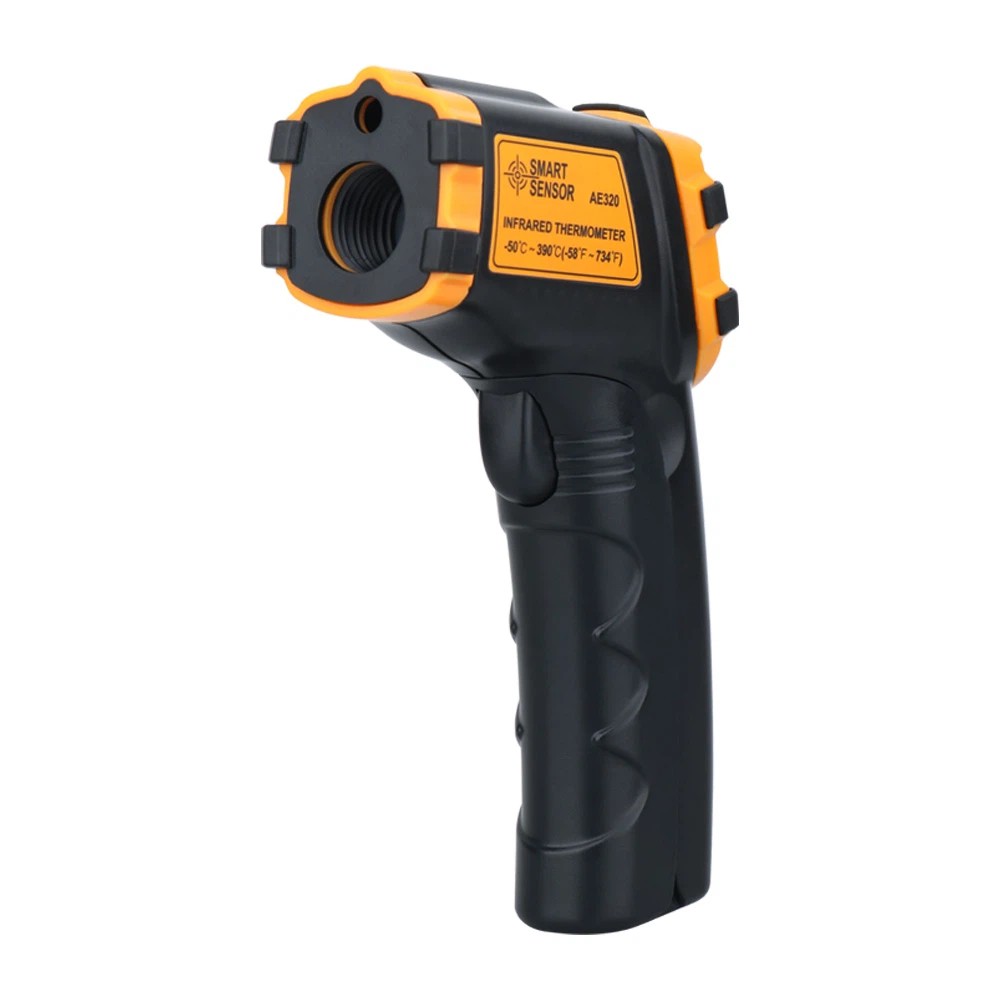
Improvement plan for infrared thermometer:
Since ordinary infrared thermometers are only limited to measuring the external temperature of an object and are inconvenient to measure the temperature inside the object and when there are obstacles, you can add a section of optical fiber to its detection head and install a small viewing angle lens at its front end. The radiant energy of the measured object passes through the lens to the inside of the optical fiber. It is transmitted to the detector after multiple reflections in the optical fiber. Because the optical fiber can be freely bent, the radiant energy can be freely redirected, which solves the problem of measuring the internal temperature of an object and can measure the temperature in corners and other places blocked by obstacles.
For example, the temperature of the plastic is measured in a plastic extruder, and the maximum temperature and average temperature of the moving blades are measured in the turbine through the gap of the stator blades, and multiple probes can be used for cycle detection.
1 Principle of fiber optic infrared temperature measurement:
The principle of optical fiber light transmission is the phenomenon of total reflection of light in different media. When light propagates from an optically denser medium to an optically rarer medium, all light will be refracted back to the optically denser medium at the boundary. The light in the fiber heart will zigzag forward without leaking.
2 Structure diagram:
The infrared radiation of the object being measured is converged to the front end of the optical fiber through the infrared probe lens. The infrared energy transmitted through the optical fiber and filtered by the infrared filter is received by the infrared detector and converted into a corresponding electrical signal. This electrical signal is amplified by the electronic circuit , the advantages of using optical fiber temperature measurement in a standard signal output mode after linearization processing
(1) The fiber optic probe has high temperature resistance and can be installed in places with high ambient temperatures.
(2) Infrared energy is transmitted through optical fibers to isolate the infrared probe from the electronic processing module, minimizing the environmental impact of the signal processing unit.
(3) The infrared radiation thermal energy signal transmitted by the fiber optic probe is completely free from electromagnetic field interference, and is especially suitable for use in strong electromagnetic field environments such as medium and high frequency induction heating equipment.
(4) It can be bent freely, allowing free conversion of radiant energy, and can measure the temperature in corners and other places blocked by obstacles.