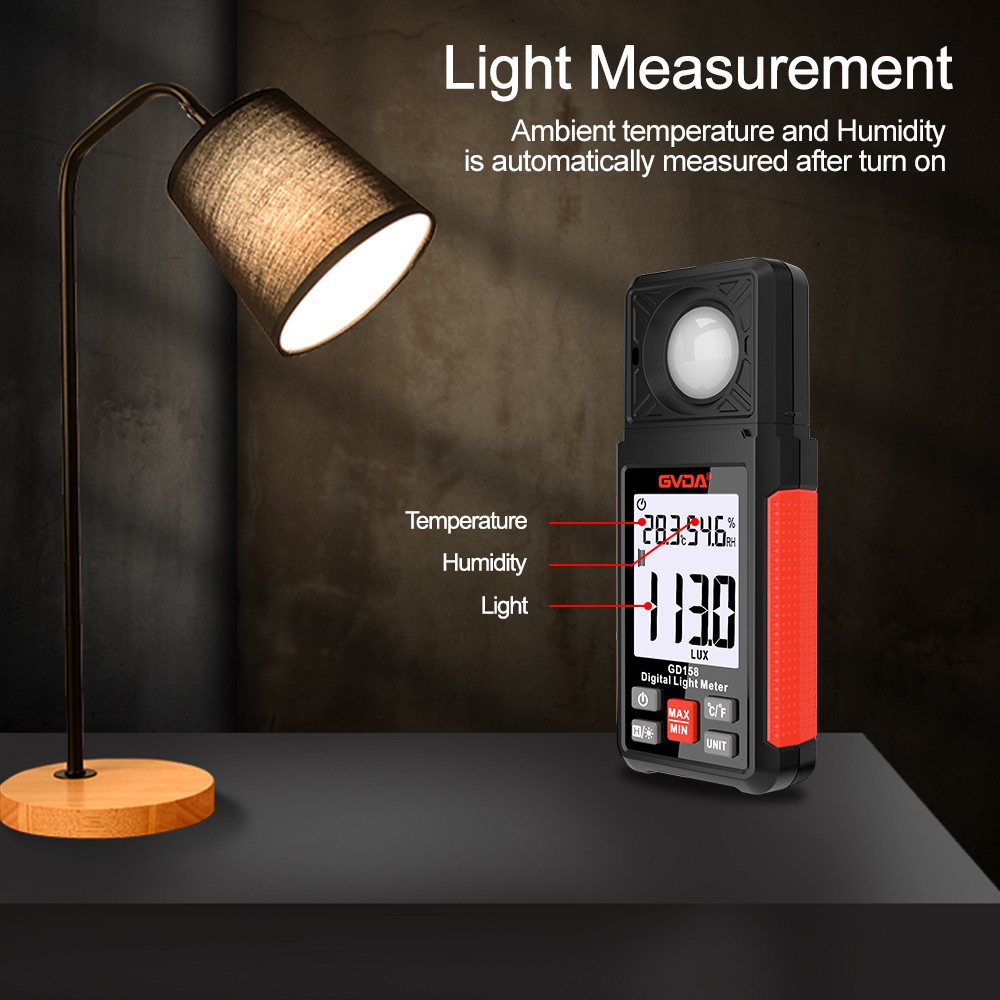
1. Small size and light weight (Compact Size, Light Weight)
Opportunities for illuminometers to be used are very extensive, and the timing of application is often in different places, so portable small size and light weight are the prerequisites for illuminance meters.
2. Accuracy﹝Accuracy﹞
Whether the illuminance meter is good or bad is closely related to its accuracy. Of course, it is also closely related to its price. Therefore, it is necessary to buy a high-accuracy illuminometer at a reasonable price. Generally, the error should not exceed ±15%.
3. Color Compensation ﹝Color Compensation﹞
The types of light sources are all-encompassing, some prefer red high-pressure lamps with longer wavelengths, or blue-violet lamps with shorter wavelengths such as Daylight fluorescent lamps; there are also more evenly distributed series such as incandescent bulbs, the same illuminometer may have slightly different sensitivity to different wavelengths. Different, so appropriate compensation is necessary.
4. Cosine Compensation ﹝Cosine Compensation﹞
We all know that the brightness of the illuminated surface is related to the incident angle of the light source. For the same reason, when measuring with an illuminometer, the sensor (Sensor) and the incident angle of the light source will naturally affect the reading value of the illuminometer. So whether a good illuminometer has the function of cosine compensation cannot be ignored.