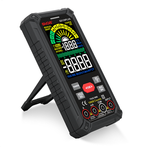
Introduction to Cup Anemometer and Propeller Anemometer
Cup anemometer
It is the most common type of anemometer. The rotating cup anemometer was first invented by Robinson in England. At that time, there were four cups, and then three cups were used. The three parabolic or hemispherical empty cups fixed on the frame are all along one side, and the whole frame together with the wind cup is mounted on a shaft that can rotate freely. Under the action of wind force, the wind cup rotates around its axis, and its rotational speed is proportional to the wind speed. The speed can be recorded by electrical contacts, tachogenerators or photoelectric counters.
propeller anemometer
It is an anemometer with a set of three or four bladed propellers rotating around a horizontal axis. The propeller is mounted on the front of a wind vane so that its rotation plane is always facing the direction of the wind coming from the anemometer, and its rotational speed is proportional to the wind speed.
What is the principle of an anemometer?
An anemometer is an instrument used to measure wind speed. There are many types. Cup anemometers are commonly used in weather stations.
It consists of three parabolic conical empty cups fixed to each other at 120° to the support.
The entire sensing part is mounted on a vertical axis of rotation. Under the action of the wind, the wind cup rotates around its axis at a speed proportional to the wind speed.
The basic principle of an anemometer is to place a thin metal wire in a fluid and apply an electric current to heat the wire above the temperature of the fluid. For this reason, anemometers are referred to as "hot wires".
As the fluid flows through the wire in a vertical direction, it removes some of the heat from the wire and reduces the temperature of the wire.
According to the theory of forced convection heat transfer, it can be deduced that there is a relationship between the heat loss Q of the hot line and the velocity v of the fluid.
A standard hot wire probe consists of two supports held taut by short thin wires. Metal wire is usually made of platinum, rhodium, tungsten and other metals with high melting points and good ductility.
The commonly used wire diameter is 5μm and the length is 2mm; the small probe diameter is only 1μm and the length is 0.2mm. According to different purposes, the hot wire probe can also be made into double wire, triple wire, diagonal, V-shaped, X shape etc.
In order to improve the strength, sometimes a metal film is used instead of a metal wire, and a layer of metal film is usually sprayed on the heat insulating substrate, which is called a hot film probe.
Hot wire probes must be calibrated before use. Static calibrations are performed in special standard wind tunnels.
Measure the relationship between flow rate and output voltage and plot it as a standard curve.
Dynamic calibration is performed in a known pulsating flow field, or added to the anemometer heating loop.
The pulsating electrical signal is used to verify the frequency response of the hot wire anemometer. If the frequency response is not good, it can be improved by using the corresponding compensation circuit.