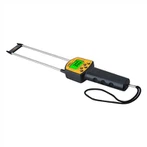
Introduction to electromagnetic radiation detector
Electromagnetic radiation detectors are mainly used for radiation measurement of electrical appliances, high-voltage lines, base stations, etc. in daily life, which can effectively help people stay away from radiation sources and avoid the harm of radiation!
Electromagnetic waves (also known as electromagnetic radiation) are waves that move in space in the form of electric and magnetic fields that oscillate in phase and are perpendicular to each other. Their propagation direction is perpendicular to the plane formed by the electric and magnetic fields, effectively transferring energy and momentum. Electromagnetic radiation can be classified by frequency, from low to high, including radio waves, microwaves, infrared, visible light, ultraviolet light, X-rays, gamma rays, and so on. The electromagnetic radiation that can be received by the human eye, with a wavelength of approximately 380 to 780 nanometers, is called visible light. Any object with a temperature greater than absolute zero can emit electromagnetic radiation, and currently, no object with a temperature equal to or lower than absolute zero has been found in the world known to humans.
Do you know how to use a radiation detector?
1. Short press the "power switch" to start, default to "magnetic field radiation intensity" detection, Gaussian alarm for more than 2 milliseconds; Press and hold the "Detection Mode Conversion" button for about 2 seconds before switching to "Electric Field Radiation Intensity" detection.
Note: The radiation detector is a high-precision measuring instrument. Due to the influence of the Earth's magnetic field, instruments sometimes display short numerical values or sound alarms. This is not a fault phenomenon.
2. Hold the electromagnetic radiation detector in your hand, point the "test area" towards the object being tested, and slowly approach the object until it actually comes into contact. The closer to the object being measured, the stronger the electromagnetic or electric field, and the faster the alarm frequency.
3. During the measurement process, try to change the angle and position of the instrument towards the measured object as much as possible to obtain a large reading.
4. If the power is turned off during the measurement process, the reading should return to zero in the "magnetic field radiation intensity detection" mode. In the "electric field radiation intensity detection" mode, some projects can still detect electromagnetic wave signals, which belong to the external electromagnetic wave signals received by the project and are harmless to the human body.
5. Pressing 'Alarm Settings' for a short period of time can set the alarm sound to on and off.
6. Short press "Peak Lock" to set the peak lock function to be enabled or disabled. The peak locking function can lock in large values during the detection process.