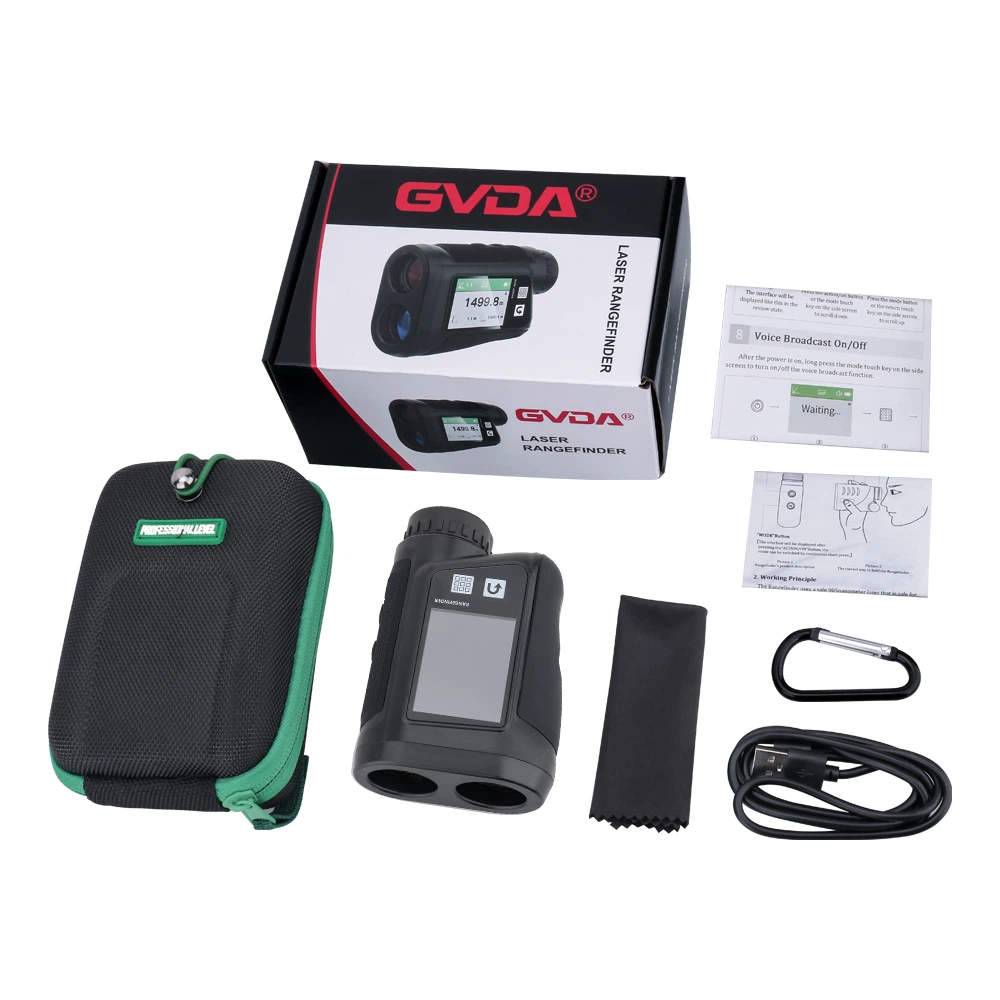
The laser rangefinder emits a very thin laser beam to the target when it is working, and the laser beam reflected by the target is received by the photoelectric element.
If the laser is fired continuously, the measuring range can reach about 40 kilometers, and the operation can be carried out day and night.
If the laser is pulsed, generally the good precision is low, but for long-distance measurement, it can achieve good relative precision.
The laser rangefinder is light in weight, small in size, simple in operation, fast and accurate, and its error is only one fifth to several hundredths of other optical rangefinders;
Therefore, it is widely used in terrain measurement, battlefield measurement, ranging of tanks, aircraft, ships and artillery to targets, and measurement of the height of clouds, aircraft, missiles and artificial satellites.
It is an important technical equipment to improve the accuracy of high tanks, aircraft, ships and artillery.
As the price of laser rangefinders continues to drop, the industry has gradually begun to use laser rangefinders.
A number of new miniature rangefinders have appeared at home and abroad with the advantages of fast ranging, small size and reliable performance, which can be widely used in industrial measurement and control, mines, ports and other fields.
main classification
1D laser rangefinder
For distance measurement and positioning;
2D Laser Rangefinder (ScanningLaserRangefinder)
For contour measurement, positioning, area monitoring and other fields;
3D Laser Rangefinder (3DLaserRangefinder)
It is used for 3D contour measurement, 3D space positioning and other fields.
Measuring principle and method of laser rangefinder
1. What is the principle of using infrared ranging or laser ranging?
The principle of ranging can basically be attributed to measuring the time required for light to travel to and from the target, and then calculate the distance D through the speed of light c=299792458m/s and the atmospheric refraction coefficient n.
Because it is difficult to measure time directly, it is usually to measure the phase of the continuous wave, which is called a phase-measuring rangefinder.
It should be noted that the phase measurement does not measure the phase of the infrared or laser, but measures the phase of the signal modulated on the infrared or laser.
The construction industry has a handheld laser rangefinder for house measurements that works the same way.
2. Must the plane of the object to be measured be perpendicular to the light?
Usually, precise ranging requires the cooperation of a total reflection prism, and the rangefinder used for house measurement is directly measured by reflection from a smooth wall, mainly because the distance is relatively close, and the signal strength of the reflected light is large enough.
It can be known from this that it must be vertical, otherwise the return signal is too weak and the maximum distance cannot be obtained.
3. Is it OK if the plane of the measured object is diffuse reflection?
Usually it is also possible. In practical projects, a thin plastic plate will be used as a reflective surface to solve the problem of serious diffuse reflection.
4. The accuracy of ultrasonic ranging is relatively low, and it is rarely used now.