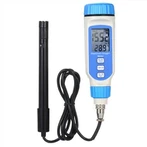
Introduction to relevant measurement principles of dissolved oxygen meters
The dissolved oxygen meter is based on the principle of electrochemistry, that is, an oxidation-reduction reaction will occur on two different metal electrodes in the electrolyte solution containing oxygen;
An instrument for measuring oxygen content in water based on the principle that there is a certain relationship between the diffusion current generated and the oxygen concentration in the solution.
Some instruments also use the polarographic method in voltammetry. After applying a voltage to the working electrode in the solution, the current on the polarogram generated has a certain relationship with the concentration of the measured substance in the solution.
In industrial production or scientific research, if it is necessary to measure the concentration of dissolved oxygen in water or solution, the Clark method is often used.
Because this method can directly convert the parameters to be measured into electrical signals, the test response is sensitive, and it is convenient for continuous online analysis, so it is widely used.
Due to the different anode materials and electrolytes selected, the Clark method is divided into electrochemical polarography and Gavanic thin film current methods.
The cathode used to measure dissolved oxygen in water by polarography is a gold or platinum electrode, and the anode is a silver electrode (Ag/AgCl reference electrode).
The electrolyte is KCl solution, and the DC power supply voltage is 0.65~0.85 V. When the anode material is changed to lead and the electrolyte is changed to KOH solution, it is the Gavanic method.
Compared with the polarographic method, the Gavanic method has a faster oxidation reaction of the anode lead, so the test reading is faster and does not require polarization. It is mostly used for general laboratory analysis. Please note that frequent maintenance is required during use.
The polarographic method must be polarized before use, but does not require frequent maintenance and is especially suitable for online analysis of continuous processes.
The dissolved oxygen electrode can be used to measure the dissolved oxygen content in the aqueous solution of the sample being measured on site or in the laboratory.
Since dissolved oxygen is one of the main indicators of water quality, dissolved oxygen electrodes can be widely used to measure dissolved oxygen content in various situations, especially in aquaculture water, photosynthesis and respiration, and on-site measurements.
Biochemical oxygen demand (BOD) testing is performed when evaluating the ability of stream and lake water to support biological survival;
Measure an aqueous sample solution containing organic matter that consumes oxygen as it becomes putrid, and determine the relationship between the dissolved oxygen concentration and the temperature of the sample aqueous solution.
Its measurement range: 0~5, 10, 20 mg/L, accuracy ±3%~±5%, response time is about 30~120 s. There are two categories: online continuous monitoring and laboratory instruments.