Introduction to Technical Parameters of Lux Meters
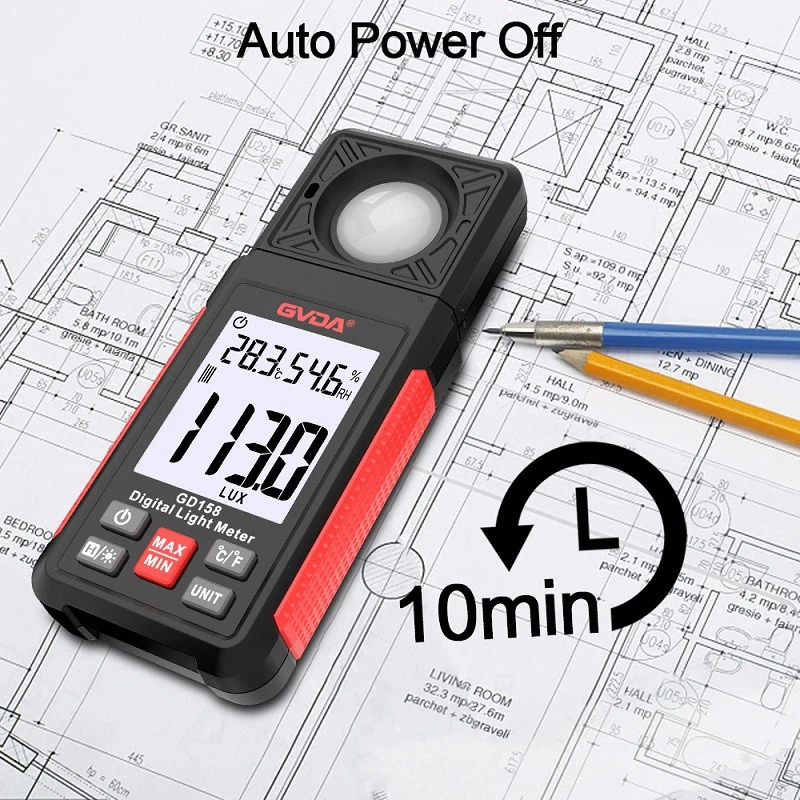
Illuminometer is a specialized instrument for measuring luminosity and brightness. It is the measurement of light intensity (illuminance), which is the degree to which an object is illuminated, that is, the ratio of the luminous flux obtained on the surface of the object to the illuminated area. An illuminance meter is usually composed of a selenium or silicon photovoltaic cell and a microampere meter.
Calibration principle:
Illuminate the photovoltaic cell vertically with Ls → E=I/r2, and change r to obtain the photocurrent values under different illuminance. Convert the current scale to the illuminance scale based on the correspondence between E and i.
Calibration method:
Using a light intensity standard lamp, at an approximate working distance of a point light source, change the distance l between the photovoltaic cell and the standard lamp, record the readings of the ammeter at each distance, and calculate the illuminance E using the inverse distance square law E=I/r2. From this, a series of different illuminance photocurrent values i can be obtained, and the variation curve of photocurrent i and illuminance E can be made, which is the calibration curve of the illuminance meter. The calibration curve of the illuminance meter can be divided by the dial of the illuminance meter, which is the calibration curve of the illuminance meter
Factors affecting the calibration curve:
When replacing photovoltaic cells and ammeters, recalibration is required; After using the illuminance meter for a period of time, it should be recalibrated (usually 1-2 times a year); High precision illuminance meters can be calibrated using standard light intensity lamps; Expanding the fixed range of the illuminance meter can change the distance r, and different standard lamps can also be used. A small range ammeter can be selected
Application scope:
1. General public places
In order to ensure that people can live under suitable lighting conditions, China has formulated hygiene standards for indoor (including public places) illuminance, and uses illuminance meters to measure illuminance in various places.
2. Lighting production industry, photography industry, stage lighting layout, etc
Illuminance meters have been successfully applied to multiple solutions, such as the lighting industry, photography industry, stage lighting layout, etc. Different models of illuminance meters can meet different measurement requirements.
3. Factory production line
In factories, the lighting requirements on production lines are relatively strict. Continuous work can cause visual fatigue and greatly reduce work efficiency. Usually, the illuminance requirement is ≥ 1000Lx. For places with high lighting requirements, a large range of illuminance meters can be selected, with a super large range that can cope with strong light illuminance measurement.
4. The application of illuminance meters is very extensive, including applications in our daily lives such as factories, warehouses, schools, offices, homes, streetlight construction, laboratories, and so on.