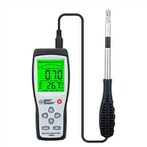
Laser range finders use both radar and lasers.
Laser Xiyuantai ranging instrument network is an active remote sensing technology that measures the distance between the sensor and the target through the laser emitted by the sensor (lidar). According to different detection targets, this technology can be divided into two categories: air detection and ground detection. Air-to-air laser ranging aims to complete the determination of the physical and chemical properties of the atmosphere by emitting a laser beam into the air and receiving echoes reflected by suspended particles in the air. The main goal of ground laser ranging is to obtain surface information such as geology, topography, landform and land use status. According to the classification of sensor-mounted platforms, laser ranging can be divided into four categories: space-borne (satellite-mounted), airborne (aircraft-mounted), vehicle-mounted (car-mounted), and positioning (fixed-point measurement).
Laser ranging technology began in the 1960s, and by the 1970s and 1980s, laser technology had become an important part of electronic ranging equipment. LIDAR (Light Detection And Ranging) usually refers to airborne ground-to-ground laser ranging technology, and the Chinese term often refers to LIDAR by laser radar. In the United States, since the 1970s, many agencies including the National Aeronautics and Space Administration (NASA), the National Oceanic and Atmospheric Administration (NOAA) and the US Department of Defense Mapping (DMA) have begun to develop LIDAR-type sensors. For oceanographic and topographic surveys. In Europe, research on laser ranging started almost at the same time as the United States. Unlike the United States, they are committed to the development of satellite platform laser ranging radar systems, and more focused on the development and research of airborne platforms and matching laser radar systems. And achieved considerable success.
By the 1990s, with the development of airborne GPS technology and portable computer systems, the stability and accuracy of the LIDAR system had been greatly improved, and it was gradually put into commercial use in Europe, and related applied research Immediately launched in Europe.
Compared with other remote sensing technologies, the research on LIDAR is a very new field, and the research on improving the accuracy and quality of LIDAR data and enriching LIDAR data application technology is quite active. Different from remote sensing imaging technology, the LIDAR system can quickly obtain the three-dimensional geographic coordinate information of the ground surface and corresponding objects on the ground (trees, buildings, ground surface, etc.), and its three-dimensional characteristics meet the mainstream research needs of today's digital earth.
With the continuous improvement of LIDAR sensors, the gradual increase in the density of surface sampling points, and the increase in the number of echoes that can be recovered by a single laser beam, LIDAR data will provide more abundant surface and surface object information. Filter, interpolate, classify, and segment the surface 3D point sets collected by LIDAR to obtain various high-precision 3D digital ground models, classify and identify surface objects and realize surface objects such as trees, 3D digital reconstruction of buildings, etc., and even drawing 3D forests, 3D city models, and constructing virtual reality. On the basis of virtual reality, a more detailed ground object analysis can be carried out to estimate the parameters of the forest land and its individual standing trees, so as to realize the management of fine forestry and agriculture; it can analyze urban planning, urban environment and urban climate Carry out simulation analysis to realize the assessment and control of sound, light and environmental pollution.