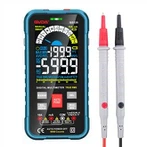
Layer Thickness Gauge Magnetic Induction Principle
Magnetic induction principle is the use of the probe through the non-ferromagnetic cladding and flow into the size of the magnetic flux of the iron substrate to determine the thickness of the cladding, the thicker the cladding, the smaller the magnetic flux. Since it is an electronic instrument, it is easy to calibrate and can be used for a variety of functions, expanding the range and improving the accuracy. Since the testing conditions can be reduced a lot, it has a wider application field than the magnetic suction type.
When the soft iron core coils around the probe on the test object, the instrument automatically output test current, the size of the magnetic flux affects the size of the induced electromotive force, the instrument will amplify the signal to indicate the thickness of the cladding. Early products with the meter head instructions, accuracy and repeatability are not good, and later developed a digital display, circuit design is also becoming more and more perfect. In recent years, the introduction of microprocessor technology and electronic switching, frequency stabilisation and other technologies, a variety of products have been introduced, the accuracy has been greatly improved, up to 1%, the resolution of 0.1µm, magnetic induction thickness gauge probe more than the use of soft steel to do the core of the magnetism of the coil current frequency is not high, in order to reduce the impact of eddy current effect, the probe has a temperature compensation function. As the instrument has been intelligent, can identify different probes, with different software and automatically change the probe current and frequency. A single instrument can be used with a variety of probes, or the same instrument can be used. It can be said that the instrument for industrial production and scientific research has reached a very practical stage.
Thickness gauge developed using electromagnetic principles, in principle, for all non-conducting magnetic cladding measurement, the general requirements of the basic magnetic permeability of 500 or more. Cladding materials that are also magnetic require a sufficiently large difference in permeability from the base material (e.g. nickel plating on steel). Magnetic principle thickness gauges can be applied to measure paint coatings on steel surfaces, porcelain and enamel protective layers, plastic and rubber cladding, various non-ferrous metal plating layers including nickel-chromium, and various anti-corrosion coatings in the chemical and petroleum industries. For photographic film, capacitor paper, plastic, polyester and other film production industry, the use of measuring platform or roll (steel manufacturing) can also be used to achieve a large area on any point of the measurement.