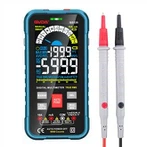
When the LED switching power supply has a fuse blown fault, it means that there is a problem with the internal circuit of the power supply.
When the power supply operates at high voltage and high current, fluctuations and surges in the grid voltage will cause the current in the power supply to increase instantaneously, resulting in the fuse being blown.
Maintenance points:
The focus is on checking the rectifier diodes at the power input end, the high-voltage filter electrolytic capacitors, the inverter power switch tubes, etc., and check whether these components have breakdown, open circuit, damage, etc.
For the problem of blown fuses, first check the various components on the circuit board to see if the surfaces of these components are burnt and whether there is electrolyte overflow. If there is no such situation, use a multimeter to measure whether the switch tube has a breakdown short circuit.
LED switching power supply fault repair
Refer to Figure 1: led switching power supply
Precautions
When a component is found to be damaged, it is forbidden to start the machine directly after replacement, because other high-voltage components are still faulty, and the replaced component will be damaged.
Only after a comprehensive inspection and measurement of all high-voltage components of the above circuit can the problem of blown fuse be completely ruled out.
2. No DC voltage output or unstable voltage output
The fuse is in good condition, and under load, there is no output of DC voltage at all levels.
Main reasons: open circuit and short circuit in the power supply, overvoltage and overcurrent protection circuit failure, auxiliary power supply failure, oscillation circuit not working, power supply overload, breakdown of rectifier diode in high frequency rectifier filter circuit, leakage of filter capacitor Wait.
After measuring the secondary components with a multimeter and ruling out the breakdown of the high-frequency rectifier diode and the short-circuit of the load, if the output is zero at this time, it is certain that the control circuit of the power supply is faulty.
If there is some voltage output, it means that the front-end circuit is working normally, and the fault is in the high-frequency rectifier and filter circuit.
The high-frequency filter circuit is mainly composed of a rectifier diode and a low-voltage filter capacitor to form a DC voltage output. The breakdown of the rectifier diode will cause no voltage output in the circuit, and the leakage of the filter capacitor will cause the output voltage to be unstable and other faults.
Damaged components can be detected by statically measuring the corresponding components with a multimeter.
3. Poor power load capacity
The poor load capacity of the power supply is a common fault, which generally occurs in old-fashioned or long-working power supplies. Due to the aging of various components, the operation of the switching tube is unstable, and the heat dissipation is not carried out in time.
Maintenance points:
It is necessary to focus on checking whether the Zener diode generates heat and leakage, the rectifier diode is damaged, the high-voltage filter capacitor is damaged, etc., to find out where the fault is, and then repair or replace the device in a targeted manner.
The three reasons for the failure of LED switching power supply have been introduced above, and I hope to be helpful to everyone.