Measurement of PROFIBUS faults with a multimeter
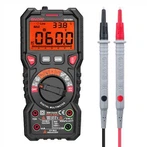
In the absence of a hand-held device and an oscilloscope, a multimeter can be used to carry out some principle tests such as PROFIBUS cable, bus connector and loop impedance tests. These tests do not provide 100% accurate values, but give a rough indication. Also, these measurements must fulfil the following prerequisites:
(1) The same components (PROFIBUS cable and plug) must be used throughout the segment, PROFIBUS components should not be connected and the PROFIBUS cable must be disconnected. It can be determined whether the cable is disconnected by measuring the voltage between the shield and the two data lines.
(2) All terminators must be disconnected, and if there are permanently connected PROFIBUS components in the
parts, such as repeaters, then those parts should be disconnected. Each segment must be measured separately.
Measurements with a multimeter can detect and locate the following errors:
● Simple "inversion" of the data lines
● Interruption of one of the two data lines
●Cable shield termination
●Short circuit between two data lines
●Short circuit between the data lines and the cable screen
Measuring loop impedance
The loop impedance is determined by measuring the impedance between the two core wires of the PROFIBUS cable. The impedance of the core wires depends on the cable construction and is also temperature-dependent. The specific cable impedance is usually specified in ohms per km at a given temperature. It corresponds to the loop impedance of a 1km long PROFIBUS cable.Typical values for PROFIBUS RS 485 cable type A have a loop impedance of 110ohm/km at 20ºC. However, for special cables, e.g. highly flexible cables, this value may be deviated from. As the temperature rises by 1ºC, the cable impedance increases by 0.4 per cent. Measuring the cable loop impedance is relatively simple.
At one end of the PROFIBUS cable, you must short-circuit (or bridge) data core A and data core B. Then, at the other end of the cable, measure the loop impedance between the two cores. Check the data sheet of the PROFIBUS cable manufacturer for the specific loop resistance (ohm/km) of the cable used. For short cables (less than 50 m), the loop impedance may be 0. Using this specific loop impedance, the length of the cable segment can be evaluated:
Length (km) = measured loop impedance (ohms) / specific loop impedance (ohm/km):
The cable loop impedance can also be assessed from knowledge of the cable length:
Loop impedance, Rloop (ohms) = cable length (km) x specific loop impedance (ohm/km)