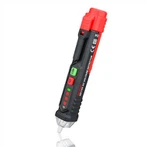
Measurement of the insulation resistance of a wire or electrical device with a multimeter.
The so-called wire leakage actually indicates that the insulation resistance of the wire or electrical equipment cannot meet the normal working conditions due to various reasons, resulting in a small resistance value between the insulated wire and the ground. For some cases where the insulation resistance value is equal to zero, it is not simply a leakage, but rather a short circuit.
Here, I will popularize the concept of insulation resistance; The so-called insulation refers to the use of relatively non-conductive substances to isolate or wrap charged objects themselves or charged objects with different voltage levels. The function of insulation; Ensure the safe operation of electrical equipment and power supply lines, and prevent the occurrence of personal electric shock accidents.
The definition of insulation resistance is; The resistance value of the insulation layer of electrical equipment under the action of DC voltage. There is no absolute "insulating" material in the world. If a direct current voltage is applied to both ends of the insulating material, there will always be a current passing through the medium, just the voltage level. The dielectric current is further divided into leakage current (leakage current, polarization capacitance current).
Simply put, the leakage grounding current of a wire is related to the moisture and aging of the insulation material. The magnitude of leakage current is related to the applied voltage, and the higher the voltage, the greater the leakage current. Their volt ampere curves are not linearly related.
Whether it is a digital multimeter or a pointer type multimeter, they are commonly used auxiliary measuring tools by electricians. Strictly speaking, a multimeter cannot measure the leakage value of a wire. In fact, using a multimeter can only preliminarily determine whether household electrical equipment or motors are powered on and whether there is leakage in the casing. At this time, a multimeter is like a test pen.
For the presence of leakage in electrical wires or equipment, a megohmmeter should be used for measurement. There are several commonly used megohmmeters, including 250V, 500V, and 1000V. As long as a megohmmeter is used to shake at a speed of 120 revolutions per minute, and its insulation resistance is greater than or equal to 0.5M Ω, it is considered to be basically qualified and can be used with confidence.
Don't think that a multimeter is omnipotent. A typical multimeter uses stacked 1.5V and 9V batteries internally. It is impossible to measure the insulation resistance of single-phase 220V or three-phase 380V AC power lines or electrical equipment.
In situations where conditions do not permit, the high resistance of a multimeter can be used to preliminarily determine the insulation resistance of wires or electrical equipment, but this method is not easily recommended for use. Using a multimeter to measure the grounding of the circuit or measuring the grounding resistance is also a preliminary judgment measurement. To truly measure the grounding resistance, a single arm or double arm bridge should be used.