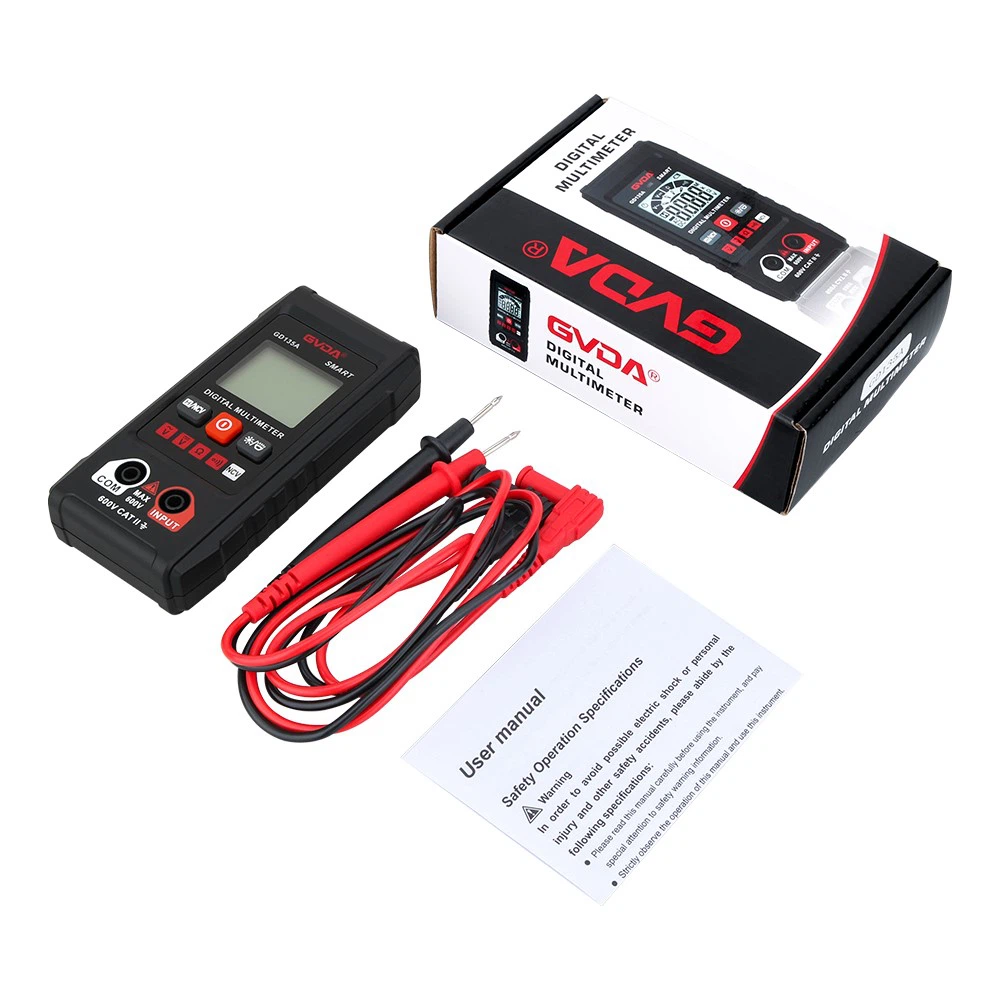
Common digital multimeter troubleshooting and maintenance techniques
For a faulty instrument, the first step is to check and distinguish whether the fault phenomenon is common (all functions cannot be measured) or individual (individual functions or ranges), and then distinguish the situation and solve it accordingly.
If all gears cannot work, the power supply circuit and A/D converter circuit should be carefully checked. When checking the power supply, remove the stacked battery, press the power switch, connect the positive probe to the negative side of the measured meter power supply, and connect the negative probe to the positive side of the power supply (for a digital multimeter). Turn the switch to the measurement position of the diode. If the display shows the positive voltage of the diode, it indicates that the power supply is good. If the deviation is large, it indicates that there is a problem with the power supply. If there is an open circuit, focus on checking the power switch and battery leads. If a short circuit occurs, it is necessary to use the circuit breaker method to gradually disconnect the components using the power supply, and focus on checking the operational amplifier, timer, and A/D converter. If a short circuit occurs, it usually damages more than one integrated component. The A/D converter can be checked simultaneously with the basic meter, which is equivalent to the DC meter head of an analog multimeter. The specific inspection method is:
(1) Turn the range of the tested meter to the lowest level of DC voltage;
(2) Measure whether the working voltage of the A/D converter is normal. According to the A/D converter models used in the table, compare the measured values with their typical values for the corresponding V+and COM pins.
(3) The reference voltage for measuring A/D converters is generally 100mV or 1V for commonly used digital multimeters, which measures the DC voltage between VREF+and COM. If it deviates from 100mV or 1V, it can be adjusted by an external potentiometer.
(4) Check the display number with zero input, short-circuit the positive terminal IN+and negative terminal IN - of the A/D converter, so that the input voltage Vin=0 and the instrument displays "00.0" or "00.00".
(5) Check the full bright strokes on the monitor. Short circuit the test pin to the positive power supply terminal V+, causing the logic ground to become high potential and all digital circuits to stop working. Due to the DC voltage applied to each stroke, all strokes light up and the alignment meter displays "1888", while the alignment meter displays "18888". If there is a missing stroke phenomenon, check if there is any poor contact or wire breakage between the output pin of the A/D converter and the conductive adhesive (or wiring), and the display.
If there is a problem with some individual files, it indicates that both the A/D converter and power supply are working properly. Because the DC voltage and resistance range share a set of voltage divider resistors; AC/DC current sharing splitter; AC voltage and AC current share a set of AC/DC converters; Other components such as Cx, HFE, F, etc. are composed of independent and different converters. Understanding the relationship between them, and then based on the power diagram, it is easy to find the faulty part. If the measurement of small signals is inaccurate or the displayed numbers have large fluctuations, focus on checking whether the contact of the range switch is good.
3. If the measurement data is unstable and the value always accumulates, short circuit the input terminal of the A/D converter, and the displayed data is not zero, then it is generally 0.1 μ Caused by poor performance of F's benchmark capacitor.
Based on the above analysis, the basic order of repairing a digital multimeter should be: digital meter head → DC voltage → DC current → AC voltage → AC current → resistance level (including buzzer and checking positive voltage drop of secondary tube) → Cx → HFE, F, H, T, etc. But it should not be overly mechanical. Some obvious problems can be dealt with first. But when conducting calibration, it is necessary to follow the above procedure.
In short, a faulty multimeter, after appropriate testing, first needs to analyze the possible location of the fault, and then find the fault location according to the circuit diagram for replacement and repair. Due to the fact that a digital multimeter is a more precise instrument, when replacing components, it is necessary to use components with the same parameters, especially when replacing A/D converters. The manufacturer's carefully selected integrated blocks must be used, otherwise errors may occur and the required accuracy may not be achieved. The newly replaced A/D converter also needs to be checked according to the method described earlier, and must not be trusted due to its novelty.