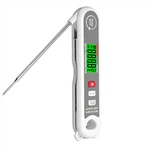
Measurement Principle Standards and Development Trends of Infrared Thermometers
There are many advantages to using an infrared thermometer for non-contact temperature measurement, ranging from small or difficult to reach objects to corrosive chemicals and sensitive surface materials. This article will discuss this advantage and explain the application scope of determining the correct choice of infrared thermometer. Due to the motion of atoms and molecules, every object emits electromagnetic waves, and the important wavelength or spectral range for non-contact temperature measurement is 0.2 to 2.0 μ m. The natural rays within this range are referred to as thermal radiation or infrared radiation.
The testing instrument for temperature measurement by the infrared radiation of the measured object is called a radiation thermometer, radiation thermometer, or infrared thermometer according to the German industrial standard DIN16160. These names also apply to instruments that measure temperature using visible colored rays emitted by the measured object, as well as instruments that derive temperature from the relative spectral radiation density.
Advantages of temperature measurement using infrared thermometers
There are many advantages to non-contact temperature measurement by receiving infrared radiation from the measured object. In this way, temperature measurements can be carried out without problems for objects that are difficult to reach or move, such as materials with poor heat transfer performance or very small heat capacity. The short response time of the infrared thermometer can quickly achieve effective adjustment of the circuit. The thermometer does not have components that can wear out, so there is no continuous cost like using a thermometer. Especially in very small measured objects, such as using contact measurement, the thermal conductivity of the object will result in significant measurement errors. There is no doubt that thermometers can be used here, as well as for corrosive chemicals or sensitive surfaces, such as on paint, paper, and plastic tracks. By remote control measurement, it is possible to stay away from hazardous areas, making operators non hazardous.
Principle and Construction of Infrared Thermometer
Focus the infrared received from the measured object on the detector through a lens and a filter. The detector generates a current or voltage signal proportional to temperature by integrating the radiation density of the measured object. In the connected electrical components, the temperature signal is linearized, the emissivity region is corrected, and converted into a standard output signal.