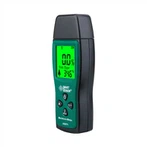
Methods and experiences of multimeter testing resistors
Fixed resistor detection. A? The actual resistance value can be measured by connecting the two pens (positive and negative) to the two pins of the resistor respectively. In order to improve the measurement accuracy, the range should be selected according to the size of the nominal value of the measured resistance. Due to the non-linear relationship of the ohm stop scale, its middle section of the index is more fine, so the pointer should be made to indicate the value as far as possible to fall into the middle position of the scale, that is, the beginning of the full scale within the range of 20% to 80% of the radian, in order to make the measurement more accurate. Depending on the resistance error level. Between the reading and the nominal resistance value are allowed to have ± 5%, ± 10% or ± 20% error, respectively. If it does not match, beyond the error range, it means that the resistance value of the value of the change in value. B?Note: When testing, especially in the measurement of tens of kΩ or more resistance value of the resistor, the hand should not touch the meter pen and the conductive part of the resistor; the resistor to be detected from the circuit to weld down at least one head, so as to avoid the other components in the circuit of the test has an impact on the test, resulting in a measurement error; colour ring resistor resistance value, although it can be used in the colour ring logo to Although the resistance value of the colour ring resistor can be determined by the colour ring marking, it is better to test its actual resistance value with a multimeter when using it.
Detection of cement resistance. The method and precautions for testing cement resistors are exactly the same as those for ordinary fixed resistors.
Detection of Fusing Resistors. In the circuit, when the fusing resistor fuses open-circuit, you can make a judgement based on experience: if you find that the fusing resistor surface black or burnt, it can be concluded that the load is too heavy, the current through it more than the rated value of many times; if the surface without any trace of open-circuit, it shows that the current flowing through the just equal to, or a little greater than, its rated value of the fusing. For the surface of the fusing resistor without any trace of good or bad judgement, with the help of a multimeter R × 1 block to measure, in order to ensure the accuracy of the measurement, the fusing resistor should be welded from the circuit at one end. If the measured resistance to infinity, the fusing resistor has failed open-circuit, if the measured resistance and the nominal value of the difference is very far, indicating that the resistance value, should not be used again. Found in maintenance practice, there are also a few fusing resistors in the circuit is broken short-circuit phenomenon, detection should also be noted. 4?
Potentiometer detection. Check the potentiometer, first of all, turn the handle to see if the handle is smooth, switch is flexible, switch on and off when the "click" sound is crisp, and listen to the potentiometer internal contacts and resistor friction sound, such as "rustle" sound, indicating that the quality is not good. Test with a multimeter, first according to the size of the measured potentiometer resistance, select a good multimeter of the appropriate resistance block, and then can be tested according to the following methods.