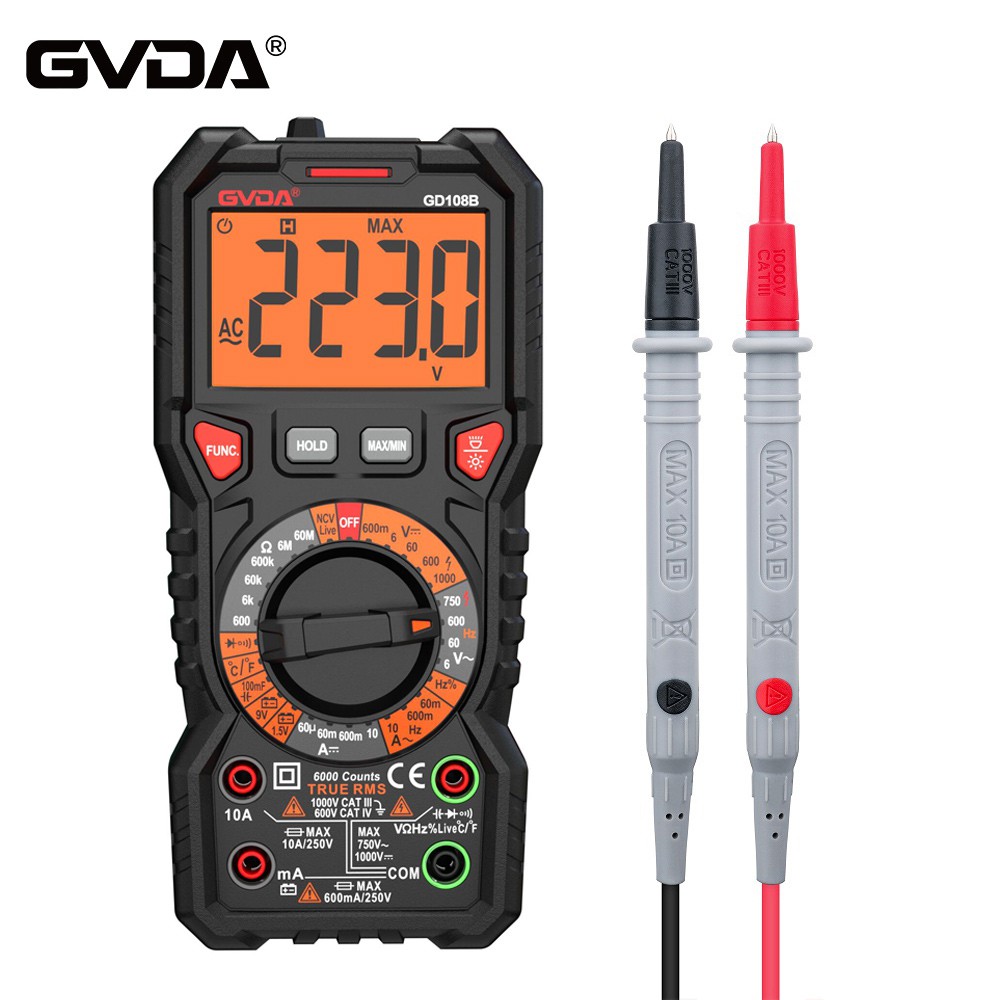
Methods and Requirements for Overhauling Digital Multimeter
A digital multimeter is an instrument that uses digital measurement technology to convert continuous analog quantities into discontinuous, discrete digital forms for display. Because the digital multimeter has the advantages of clear display, intuitive and accurate reading, avoiding the reading error of the pointer multimeter, wide measurement range, fast measurement speed, high resolution, strong anti-interference ability, complete protection circuit and high input impedance, it is widely used. Conventional test items for digital multimeters used in electronic measurement include: DC and AC voltage, resistance, diode, on-off test with sound, and transistor test.
Key Points for Overhauling Digital Multimeters
Overhauling digital multimeters is a painstaking and meticulous work, and sometimes it takes a lot of energy and hard work. Therefore, it is very important to continuously accumulate data and sum up experience. A technical file should be established for each digital multimeter and numbered uniformly. Each multimeter must carefully fill in the acceptance verification card, repair card, and regular calibration card. This has two advantages. It is to establish a complete technical file for each instrument, and the second is to help improve the technical level of repair personnel. The repair process is also a sequential process of practice-theory-practice. Every time a digital multimeter is repaired, there will always be gains and new experiences. If you don't organize and record them in time, you will inevitably forget them after a long time. The repetition rate of common faults is high, and it is possible to quickly find out the cause by reviewing past records. Some failures are related to operators, and the reasons need to be told to them to avoid similar failures in the future. Some special failures have less chances to occur, and it takes a lot of trouble to eliminate them. Recording them will be of reference value for future work. The records should be concise and concise, able to explain the problem. In addition, maintenance personnel are also encouraged to sort out the notes, focusing on recording how to eliminate the false and preserve the true according to the phenomenon, analyze and judge, and gradually determine the cause of the failure. Here, quick thinking and correct reasoning are crucial. You should also write down which judgments you initially made were wrong and why. Some important ideas, such as the idea of improving the instrument circuit, are fleeting, and it is more necessary to write them down.
General Procedures for Troubleshooting a Digital Multimeter
Overhauling a digital multimeter is like a doctor seeing a patient. You may wish to borrow the four-character formula of "look, smell, ask, and cut" commonly used in traditional Chinese medicine diagnosis.
Look: first perform a visual inspection of the instrument to check the damage, whether there is mechanical damage, electrical damage, missing parts, etc.;
Smell: listen to the user's introduction to the damage process of the instrument, the abnormal phenomena seen when the fault occurs, etc. ;
Question: For doubtful points, ask a few more reasons, such as whether the operator has misoperation, whether the overcurrent and overvoltage protection circuit of the instrument has an open circuit or short circuit fault;
Cutting: Carry out practical analysis, draw the maintenance flow chart when necessary, and create favorable conditions for rapid troubleshooting;
Looking, smelling, asking, and doing everything belong to investigation and research and analysis of the cause of the failure, so as to be aware of it.
Repairing the digital multimeter needs to be carried out with reference to the circuit diagram. It is more convenient if there are printed circuit and component assembly diagrams: the product manual of the digital multimeter generally does not provide circuit diagrams, which brings great difficulties to maintenance. If necessary, you should survey and map the whole machine circuit or only the circuit involving the faulty part. You can also refer to the whole machine circuit or unit circuit of the digital multimeter provided in relevant books.
Troubleshooting generally begins with the power supply. If there is no display on the LCD after turning on the power, first check whether the voltage of the 9V laminated battery is too low, whether the battery leads are disconnected, and whether the power switch is damaged. If the voltage of the power supply battery is normal, but the voltage cannot be measured from the single-chip A/D converter, it is usually due to an open circuit of the battery lead or poor contact inside the power switch. . Troubleshooting should try to be thorough, leaving no hidden dangers, and no chances.