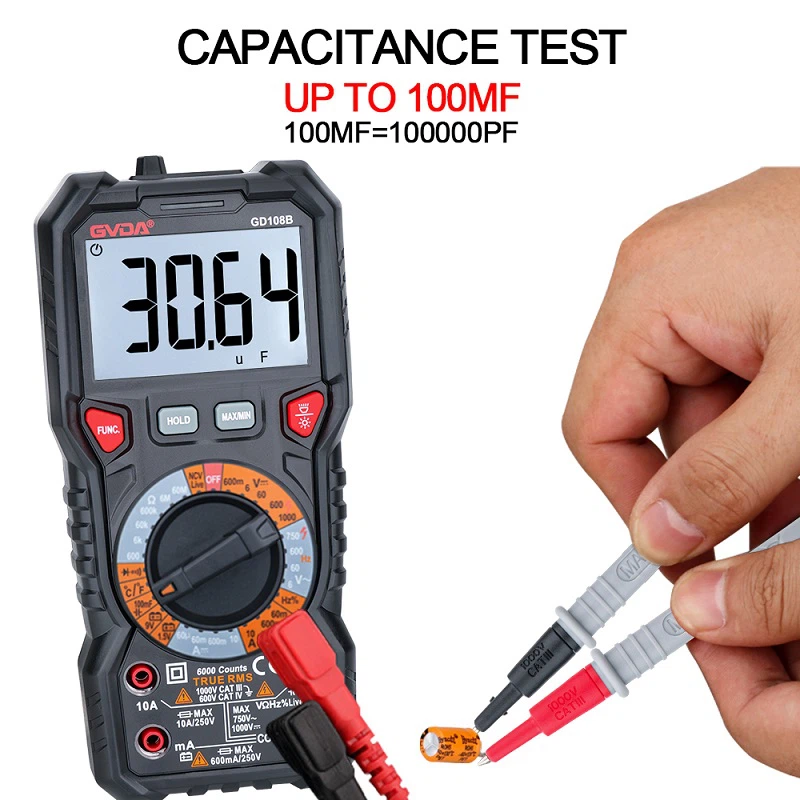
Methods and Steps for Measuring Voltage with a Multimeter
1. Preparation work
Before conducting measurements, it is necessary to first confirm whether the power supply of the tested circuit has been turned off and whether the multimeter is in normal working condition. Then, select the appropriate voltage measurement gear.
2. Choose the appropriate voltage measurement gear
A multimeter typically provides multiple voltage measurement settings. In order to obtain accurate measurement results, it is necessary to select the appropriate gear based on the estimated range of the measured voltage. If the voltage to be tested may be very high, it is necessary to choose a higher gear, otherwise choose a lower gear.
3. Wiring
Connect the red probe of the multimeter to the positive voltage input terminal and the black probe to the negative voltage input terminal. The red probe is usually connected to the "V Ω mA" socket, while the black probe is connected to the "COM" socket.
4. Measure voltage
Connect the black probe (common probe) to the ground wire of the tested circuit, which is the zero potential point in the circuit. Then connect the red probe to the measuring point of the voltage to be measured. Ensure good connection between the two probes and the circuit. After the connection is completed, the power can be turned on.
5. Read the measurement results
When measuring voltage, it is necessary to read the measurement results on the display screen of the multimeter. If the multimeter has an automatic range selection function, it will automatically select the appropriate range to measure voltage. If the multimeter does not have an automatic range selection function, it is necessary to match the range of the voltage to be measured by rotating the knob for selecting the gear. When reading voltage measurement results, be sure to keep your eyes perpendicular to the dial to avoid visual deviation.
6. Turn off the power
After completing the measurement, it is necessary to turn off the power and disconnect the multimeter from the circuit being tested.
The gear selected when measuring voltage with a multimeter depends on the magnitude of the voltage being measured. Here are some commonly used gear selection guidelines:
When the estimated voltage is higher than 10V, select 20V or higher in the DCV (direct current voltage) mode.
When the estimated voltage is below 10V but above 1V, select the DCV gear of 2V or higher.
When the estimated voltage is below 1V, select 200mV or higher in the DCV gear.
Generally speaking, it is advisable to choose a gear with an appropriate range to ensure accurate measurement results and avoid situations where the current overflows or is too small to measure.